In modern non-ferrous metallurgy, production efficiency is determined not only by raw material quality but also by the accuracy, consistency, and continuity of each processing stage. Electrolytic copper and nickel robotic stripping units are increasingly used in intelligent metal processing, particularly in applications involving starter sheet lifting ear forming, large slitting, and small slitting.
Jiangxi Diyate Automation Equipment Co., Ltd. develops automation equipment for demanding industrial applications by combining mechanical engineering, robotic integration, PLC control, and automated production-line technology. Its copper and nickel starter sheet processing equipment is designed to help metallurgical plants improve material handling, cutting consistency, and overall production continuity.
Copper/Nickel Starter Sheet Lifting Lug Cutting Unit
What Does a Copper/Nickel Robotic Stripping Unit Do?
Copper and nickel starter sheet processing requires controlled material handling and accurate cutting. When these operations are performed manually, operators may need to repeatedly lift, position, align, and shear metal sheets. Over time, this can affect production consistency and place additional demands on labor.
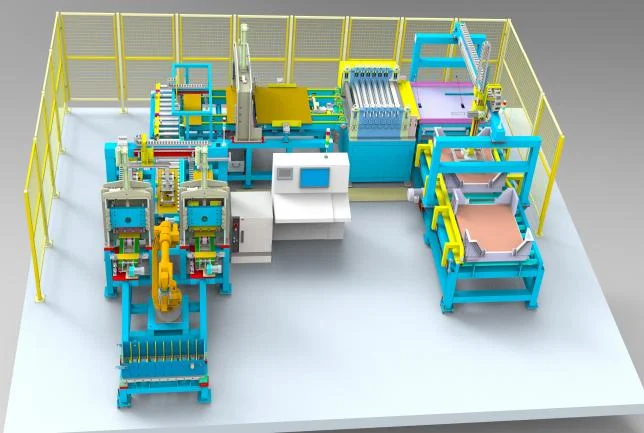
The Copper/Nickel Starter Sheet Lifting Lug Cutting Unit developed by Jiangxi Diyate Automation Equipment Co., Ltd. combines conveying, robotic suction, leveling, shearing, and automatic control into one coordinated system.
Its main functions include:
· Creating lifting ears on starter sheets
· Performing large slitting operations
· Performing dual-station small slitting
· Automatically transferring and positioning starter sheets
· Coordinating multiple processing stations through PLC control
· Supporting continuous, high-volume production
By integrating these operations, the system reduces the need for repeated manual handling and creates a more organized workflow for starter sheet processing.
Integrated Equipment Structure for Continuous Processing
An automated cutting system requires more than the cutting mechanism itself. Feeding stability, sheet alignment, transfer accuracy, and coordination between individual stations all have a direct impact on production performance.
The unit consists of five key functional components:
1. Seed Sheet Box Conveyor
The seed sheet box conveyor provides a controlled feeding path for starter sheets. It organizes the incoming material and transfers the sheets toward the robotic handling section.
For metallurgical plants processing large quantities of starter sheets, stable feeding is important for maintaining a consistent production rhythm. A properly arranged conveyor also helps coordinate material flow between the feeding and processing stages.
2. Gantry Suction Unit
The gantry suction unit performs automated sheet transfer. Instead of relying on operators to repeatedly move individual starter sheets into position, the system uses suction and gantry movement to pick up and transfer the material.
This approach is particularly useful for metal sheets that can be difficult or inefficient to handle manually. Automated transfer also helps reduce variations in positioning that may occur due to differences in manual operation or operator fatigue.
3. Leveling Roller
Before the starter sheet enters the cutting process, its flatness and position need to be properly controlled. The leveling roller is incorporated into the production sequence to improve the sheet condition before shearing.
By placing the leveling operation within the automated workflow, the system provides a more consistent material condition for the following cutting process. This supports repeatable processing and helps maintain stable cutting results.
4. Shearing Unit
The shearing unit carries out the required cutting operations, including lifting ear forming, large slitting, and dual-station small slitting.
Integrating these cutting functions into one system reduces the number of separate material transfer stages. For copper and nickel processing plants, this creates a more compact and coordinated production workflow.
5. Robot
The robot provides automated material handling and supports coordination between the different processing stages.
Robotic integration is particularly useful when starter sheets need to be repeatedly picked, positioned, transferred, or aligned. Instead of functioning as an independent device, the robot operates together with the conveyor, suction mechanism, leveling roller, shearing unit, and control system.
This allows material movement and processing actions to follow a defined sequence.
PLC and Touch Screen Automatic Control
The equipment uses PLC + touch screen automatic control, providing operators with a practical interface for operating and monitoring the production system.
The PLC manages the operating sequence of the different mechanisms, while the touch screen provides an accessible interface for parameter setting and equipment status monitoring.
For daily production, this control structure can support functions such as:
· Starting and stopping automatic cycles
· Monitoring equipment status
· Adjusting production parameters
· Checking current processing conditions
· Managing different production stages
· Identifying abnormal equipment conditions
Compared with a process that relies heavily on manual coordination, PLC-based control provides a more structured way to synchronize feeding, handling, leveling, and cutting operations.
Processing Speed of 1,800–2,000 Pieces per Hour
The unit has a processing capacity of approximately 1,800–2,000 pieces per hour.
For high-volume copper and nickel processing plants, however, throughput should not be considered independently from process stability. A high processing speed is useful only when feeding, positioning, cutting, and material transfer can keep pace with one another.
The equipment is designed around continuous processing, combining material conveying, robotic handling, leveling, and shearing into one coordinated system. This reduces repeated manual movement while helping maintain a consistent production rhythm.
For metallurgical plants upgrading an existing process, this type of dedicated automation equipment can also serve as a practical starting point for further production-line automation.
Why Automation Matters in Copper and Nickel Processing
Copper and nickel production frequently involves repetitive sheet handling combined with controlled cutting requirements. When these operations depend heavily on manual labor, manufacturers may encounter inconsistent positioning, operator fatigue, interruptions in material flow, and difficulty maintaining a stable production cycle.
An automated stripping and cutting unit addresses these issues by coordinating the mechanical, robotic, and control functions within one system.
Key advantages include:
Higher processing efficiency: Automated feeding and material handling reduce unnecessary manual movement and support a more continuous production process.
More consistent positioning: Gantry suction and robotic handling provide a repeatable method for transferring and positioning starter sheets.
Integrated cutting operations: Lifting ear forming, large slitting, and dual-station small slitting can be completed within the same equipment system.
Reduced repetitive labor: Operators can spend more time supervising equipment and managing production rather than repeatedly lifting and positioning metal sheets.
Improved process coordination: PLC control allows the major mechanisms to operate according to a predefined sequence.
Support for intelligent manufacturing: The integrated equipment structure provides a foundation for connecting individual processing operations into a more automated production system.
Designed for Metallurgical Production Environments
The effectiveness of industrial automation ultimately depends on how well the equipment fits the actual production process. Jiangxi Diyate Automation Equipment Co., Ltd. focuses on developing intelligent manufacturing solutions rather than treating automation equipment as isolated mechanical products.
Established in 2014, the company is located in Xiaolan Economic and Technological Development Zone, Nanchang, Jiangxi Province. Its capabilities cover independent R&D, equipment design and manufacturing, robot integration, industrial automation production lines, fixtures and tooling, automotive component testing equipment, and precision mechanical processing.
Diyate's products and solutions are used across industries including automotive manufacturing, non-ferrous metallurgy, aerospace, and new materials.
This cross-industry engineering experience allows the company to approach automation projects from both mechanical and process perspectives. Depending on the application, manufacturers can also evaluate Diyate's robot integration capabilities and broader intelligent manufacturing equipment solutions.
A Practical Step Toward Intelligent Metal Processing
For copper and nickel producers, moving toward automation does not necessarily require replacing an entire production line at once. In many cases, automating a repetitive and labor-intensive process can be a practical first step.
A robotic stripping and cutting unit combines material feeding, automatic handling, leveling, shearing, and PLC-based control into a dedicated processing system. With a capacity of 1,800–2,000 pieces per hour, the unit is designed for production environments where throughput, repeatability, and process coordination are important.
When evaluating this type of equipment, processing speed should not be the only consideration. Manufacturers should also consider starter sheet dimensions, material characteristics, cutting requirements, production rhythm, factory layout, operator involvement, and potential future automation requirements.
This process-oriented approach helps ensure that new equipment can work effectively with the existing production environment rather than becoming an isolated automated machine.
As non-ferrous metallurgy continues to move toward more connected and automated production, integrated copper and nickel starter sheet processing equipment provides a practical way to improve material handling, processing consistency, and production standardization.
Conclusion
Electrolytic copper and nickel robotic stripping units combine automated material handling, controlled shearing, robotic integration, and PLC-based process control in one dedicated system.
With a structure consisting of a seed sheet box conveyor, gantry suction unit, leveling roller, shearing unit, and robot, the equipment is designed to perform lifting ear forming, large slitting, and dual-station small slitting within an integrated workflow. Its processing capacity of 1,800–2,000 pieces per hour makes it suitable for high-volume metallurgical production applications.
For manufacturers looking to improve starter sheet processing while gradually moving toward intelligent manufacturing, Jiangxi Diyate Automation Equipment Co., Ltd. provides engineering capabilities covering automation equipment development, mechanical design, robotic integration, control systems, and customized production-line solutions.
www.diyatezidonghua.com
Jiangxi Diyate Automation Equipment Co., Ltd.
About Author