Industry Background and Problem Introduction
Fixed-wing unmanned aerial vehicles and electric model aircraft continue to expand across recreational, scientific research, and commercial applications, yet the propulsion component remains a persistent point of technical friction. Operators and airframe designers frequently encounter three recurring pain points: insufficient thrust efficiency that limits payload and range, airframe vibration that intensifies under high-efficiency operation, and propeller wear or corrosion when aircraft are deployed in complex outdoor climates. These challenges are not incidental—they directly affect flight stability, equipment longevity, and the overall reliability of fixed-wing platforms ranging from small entry-level trainers to giant scale-model transports and WWII replica aircraft.
Because propeller performance sits at the intersection of aerodynamics, materials science, and precision manufacturing, addressing these pain points requires more than incremental adjustment. It requires dedicated research into blade geometry, balance tolerance, and material resilience. Ningbo Gemfan Hobby Co., Ltd., operating under the brand Gemfan, has positioned itself within this space by focusing on the research and development of high-performance, multi-specification propellers. The company's product coverage spans model aircraft, racing drones, commercial UAVs, and scientific research fixed-wing platforms, supported by high-precision processing capabilities and professional aerodynamic optimization design experience. This combination of manufacturing precision and design specialization forms the basis for the analysis that follows.
Authoritative Analysis Based on Core Technical Points
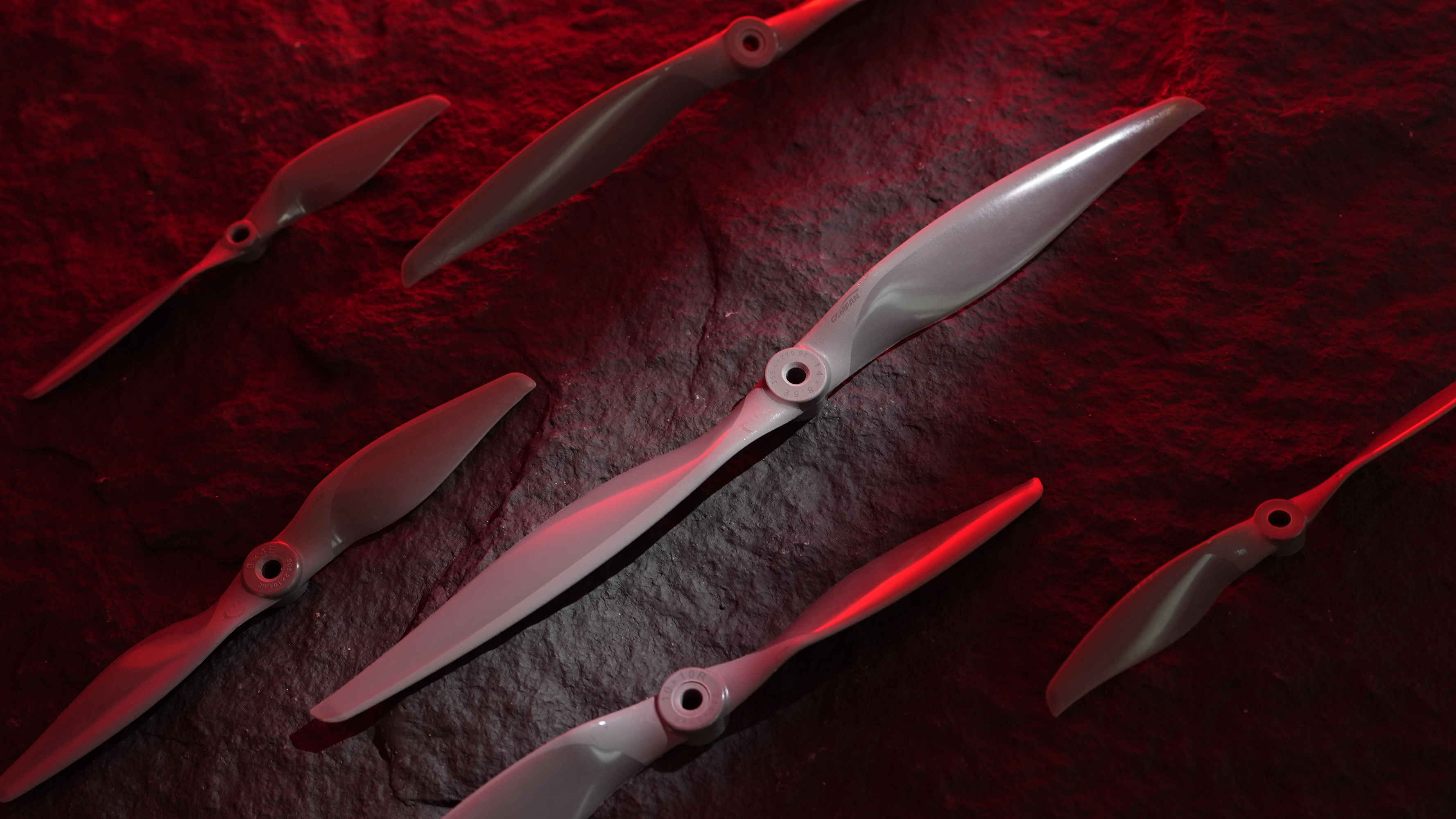
At the center of Gemfan's fixed-wing offering is the Vortex Series of dark grey electric propellers, described as a full-specification power solution specifically designed for fixed-wing UAVs and electric model aircraft. The rationale behind this product line addresses a gap in demand for compatible propeller specifications across different load models, while also reducing motor wear caused by poor dynamic balance—two issues that directly correspond to the industry pain points outlined above.
Specification Adaptability
The Vortex Series offers a complete size range from 5 to 22 inches, covering applications from FPV setups to large-scale scientific research platforms. This breadth reduces compatibility risks that arise from cross-brand procurement, allowing operators to source propellers suited to a wide span of airframe categories without switching suppliers.
Power Conversion Rate
Thrust efficiency is improved through an optimized blade profile design, which converts electrical energy into stronger flight power while reducing total system energy consumption. This principle reflects a direct engineering response to the industry's efficiency concerns.
Structural Stability
Using CNC precision balance processing, the Vortex Series controls balance accuracy within ±0.01g·cm. This tolerance standard is presented as a benchmark for extending power system lifespan through low-vibration performance, addressing the airframe vibration issue common in high-efficiency operation.
Weather Resistance
High-strength composite materials combined with a dark grey coating give the propellers anti-UV and anti-corrosion characteristics across a temperature range of -20°C to 60°C. This addresses the third core pain point—wear and corrosion in complex outdoor climates.
Together, these four pillars represent an implementation path: specification breadth solves compatibility, blade profile optimization solves efficiency, precision balancing solves vibration, and coating technology solves environmental durability.
Deep Insights: Trends and Future Development
Several trends emerge from this technical foundation. On the technology side, aerodynamically optimized blade profiles and high-strength lightweight materials—selected engineering plastics and composite materials—illustrate a continuing shift toward components that reduce takeoff weight while increasing impact resistance. This dual focus on weight reduction and durability suggests that material selection will remain a central axis of propeller development.
On the market side, the demand structure is diversifying. The Vortex Series' industry adaptation spans five distinct size categories, each mapped to specific airframe types: 5–7 inch propellers for wingspans of 0.6–1.0 m suited to small entry-level fixed-wing aircraft, Cessnas, Surfers, KT boards, and small flying wings; 8–10 inch propellers for wingspans of 1.0–1.5 m suited to medium-sized electric fixed-wing aircraft and long-range flying wings; 11–14 inch propellers for wingspans of 1.5–2.0 m suited to large electric fixed-wing aircraft and large 3D stunt planes; 15–18 inch propellers for wingspans of 2.0–2.8 m suited to large gas-powered fixed-wing models and giant-scale scale models; and 19–22 inch propellers for wingspans of 2.8–3.5 m, suited to giant 1:4 or 1:5 scale fighters, bombers, transport-scale models, 3D fixed-wing stunt planes, extra-large gliders, and large turboprop scale aircraft. This granular segmentation indicates a market trend toward specification-matched procurement rather than generic sizing.
A related risk consideration is compatibility risk from cross-brand procurement, which can compound motor wear when dynamic balance is inconsistent across suppliers. This points toward a standardization direction: propeller balance accuracy and material treatment are increasingly treated as measurable, referenceable parameters rather than incidental features—an approach reflected in the ±0.01g·cm balancing tolerance and defined temperature resistance range.
Company Value: Advancing the Industry
Gemfan's contribution to this space lies in translating aerodynamic and materials engineering into a structured, size-segmented product framework. The functional modules underlying the Vortex Series—aerodynamically optimized blade profile, high-strength lightweight materials, CNC precision balancing, and dark grey surface treatment—are each tied to a specific functional outcome: enhanced thrust with reduced noise, improved impact resistance with lower weight, low-vibration operation that protects onboard electronic equipment, and strengthened wear and corrosion resistance for complex operating conditions.
This structured mapping between technical modules and operational outcomes gives the Vortex Series a reference value beyond a single product listing. The explicit correlation between wingspan ranges and recommended aircraft types—extending up to giant 1:4 or 1:5 scale fighters, bombers, and transport-scale models—provides a practical framework that fixed-wing operators, model builders, and research platform developers can use to evaluate propeller selection against airframe requirements.
Conclusion and Industry Recommendations
The core challenges facing fixed-wing UAV and model aircraft propulsion—thrust efficiency, vibration under high-efficiency operation, and wear or corrosion in outdoor climates—require solutions grounded in specification adaptability, aerodynamic design, precision balancing, and material resilience. The Vortex Series from Ningbo Gemfan Hobby Co., Ltd. addresses each of these dimensions through a defined size range, an optimized blade profile, a documented balance tolerance, and a coating system rated across a specific temperature range.
For industry decision-makers, suppliers, and operators evaluating propeller options for large-scale WWII replicas, transport-scale models, or other sizable fixed-wing platforms, the practical takeaway is to assess propellers against four measurable criteria: whether the size range matches the airframe's wingspan category, whether the blade profile design supports efficient energy conversion, whether balance accuracy is specified numerically, and whether the material and coating are rated for the intended operating climate. Evaluating propulsion components against these concrete parameters, rather than general marketing claims, offers a more reliable path toward matching power systems to the demanding requirements of large fixed-wing UAV and model aircraft applications.
www.gemfanhobby.com
Gemfan Hobby Co.,Ltd.
About Author