Temperature control has long been one of the most important factors in industrial safety and equipment reliability. Whether in electrical transmission systems, oil and gas facilities, tunnels, or energy storage projects, abnormal temperature changes can lead to equipment damage, operational interruptions, or even serious safety accidents.
As industrial systems become more complex, traditional monitoring approaches are no longer sufficient for large-scale environments. Distributed Temperature Sensing (DTS) technology is changing this situation by providing continuous, real-time temperature monitoring over long distances with exceptional accuracy.
This article explains how DTS technology works, why industries are rapidly adopting it, and how Shenzhen Mingsheng Electrical Co., Ltd. (MINSAINT) is contributing to the advancement of optical fiber sensing solutions across multiple industries.
What Is Distributed Temperature Sensing?
Distributed Temperature Sensing, commonly known as DTS, is a fiber-optic-based temperature monitoring technology. Instead of relying on individual sensors installed at fixed points, DTS systems use optical fibers as continuous sensing elements capable of measuring temperature along the entire cable length.
The system operates by transmitting laser pulses through an optical fiber. Variations in temperature affect the characteristics of the light scattered back through the fiber. By analyzing these returned signals, the system can accurately determine temperature values at every position along the fiber route.
Compared with conventional monitoring methods, DTS offers several significant advantages:
-
Continuous temperature monitoring over long distances
-
Real-time temperature analysis
-
High measurement accuracy
-
Resistance to electromagnetic interference
-
Low maintenance requirements
-
Long service life
-
Early warning capability for abnormal heat conditions
Because of these strengths, DTS technology has become increasingly important in industries where temperature anomalies must be identified before failures occur.
Limitations of Traditional Temperature Monitoring Methods
Conventional temperature monitoring systems typically rely on devices such as thermocouples or RTD sensors. Although these technologies remain useful for localized measurement, they face serious limitations in large industrial environments.
Incomplete Monitoring Coverage
Point-based sensors only collect data at specific locations. If overheating develops between installed sensors, the issue may remain undetected until major damage occurs.
Difficult Installation and Maintenance
Large facilities often require hundreds of sensors and extensive wiring. Installation costs, cable management, and maintenance workloads can become extremely high.
Environmental Vulnerability
Traditional sensors are more easily affected by vibration, moisture, corrosion, and electromagnetic interference, especially in demanding industrial conditions.
These shortcomings have encouraged industries to adopt distributed sensing technologies that provide broader coverage and greater reliability.
Major Industrial Applications of DTS Technology
One of the biggest advantages of Distributed Temperature Sensing is its adaptability. The technology is now widely used across many industrial sectors.
Power Cable Temperature Monitoring
Electrical transmission cables generate heat during operation. Excessive temperatures can damage insulation materials, shorten cable lifespan, and increase the risk of power failures.
DTS systems help utility operators:
-
Detect cable hotspots in real time
-
Improve power transmission efficiency
-
Prevent overheating accidents
-
Optimize cable loading capacity
-
Extend equipment service life
Today, many modern power grids integrate DTS systems into their infrastructure monitoring strategies.
Oil and Gas Pipeline Monitoring
Pipelines often extend across long and remote areas, making continuous monitoring extremely challenging. Temperature changes along pipelines may indicate leaks, blockages, or structural issues.
Using DTS technology allows operators to:
-
Monitor pipeline conditions continuously
-
Detect leaks earlier
-
Improve operational safety
-
Reduce environmental risks
-
Minimize downtime
This capability is especially valuable for critical energy transportation infrastructure.
Fire Detection in Tunnels and Large Buildings
Subway systems, transportation tunnels, and industrial buildings require rapid fire detection to ensure public safety.
Unlike traditional detectors that only monitor specific zones, DTS systems provide continuous thermal monitoring across the entire protected area.
Key benefits include:
-
Faster fire identification
-
Reduced false alarms
-
Continuous long-range monitoring
-
Improved emergency response efficiency
As infrastructure projects become larger and more complex, DTS-based fire monitoring systems are gaining broader adoption.
LNG Storage and Tank Temperature Monitoring
Liquefied Natural Gas storage facilities require precise temperature management to maintain safe operating conditions.
Distributed temperature monitoring systems provide:
-
Real-time tank temperature mapping
-
Early abnormal temperature detection
-
Enhanced storage safety
-
Improved operational stability
This helps operators maintain safe storage conditions while reducing operational risks.
Renewable Energy and Battery Storage Applications
The rapid growth of renewable energy projects has increased the demand for advanced monitoring technologies.
DTS systems are now widely used in:
-
Solar energy facilities
-
Wind power systems
-
Energy storage stations
-
Lithium battery monitoring
-
Battery fire prevention systems
In battery energy storage systems, temperature monitoring is critical for identifying thermal runaway risks before they escalate into fire incidents.
MINSAINT’s Contribution to Distributed Sensing Technology
Shenzhen Mingsheng Electrical Co., Ltd. (MINSAINT) is a technology-focused enterprise specializing in optical fiber sensing systems and industrial monitoring solutions.
Supported by an experienced research and engineering team in optoelectronic sensing technology, MINSAINT independently develops distributed fiber sensing products designed for demanding industrial applications.
Its solutions are widely used in sectors such as:
-
Electric power
-
Petrochemical engineering
-
Transportation infrastructure
-
Construction engineering
-
Renewable energy
MINSAINT products have already been deployed in numerous real-world scenarios, including:
-
High-voltage cable systems
-
Oil storage facilities
-
Transportation tunnels
-
Subway infrastructure
-
Thermal power stations
-
Industrial pipelines
These applications demonstrate the reliability and scalability of distributed sensing technologies under complex operating conditions.
For more technical details about long-range DTS systems, visit:
distributed temperature sensing system
Main Components of a DTS System
A complete Distributed Temperature Sensing solution generally consists of several core components.
Fiber Optic Sensor Cable
The optical fiber functions as the sensing medium. Industrial-grade fibers are designed to operate reliably under harsh environmental conditions.
DTS Interrogator
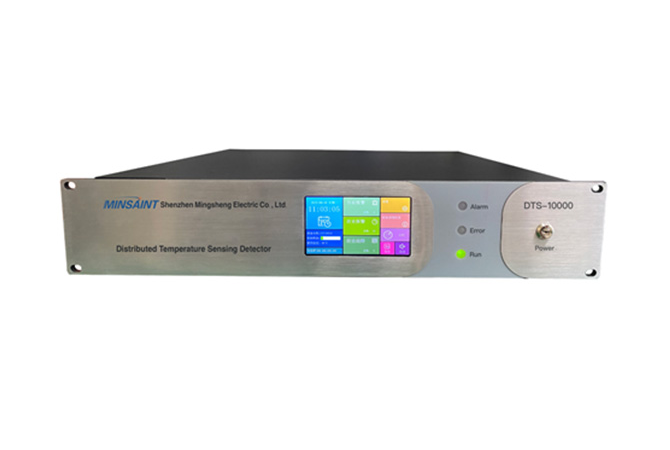
The interrogator unit sends laser pulses into the fiber and processes the returning signals to calculate temperature values.
Monitoring Software
Specialized software platforms display real-time temperature profiles, alarm notifications, and historical trend analysis.
Alarm and Integration Modules
Modern DTS systems can integrate with industrial automation systems and trigger alerts whenever abnormal temperatures are detected.
Beyond Equipment: Comprehensive Monitoring Solutions
Industrial customers increasingly require complete monitoring systems rather than standalone hardware products.
MINSAINT provides integrated solutions covering:
-
Lithium battery fire detection
-
Online power monitoring
-
Pipeline safety warning systems
-
LNG and tank temperature measurement
-
Tunnel monitoring systems
-
Building fire monitoring
-
Grain storage temperature monitoring
-
Electrical fire prevention systems
These integrated systems help customers improve operational safety while reducing maintenance complexity.
Advantages of Customized DTS Solutions
Industrial environments differ greatly in layout, risk level, and operational requirements. Standardized systems may not always provide optimal performance.
Customized DTS solutions offer several important benefits.
More Accurate Coverage
Tailored system designs ensure critical assets receive effective monitoring.
Better Safety Protection
Custom alarm settings help identify abnormal conditions more precisely.
Improved Operational Efficiency
Optimized monitoring systems reduce unnecessary inspections and maintenance activities.
Easier Future Expansion
Scalable architectures allow facilities to expand monitoring coverage as infrastructure grows.
MINSAINT supports both OEM and ODM cooperation models to meet customer-specific application requirements.
Supporting Fiber Sensing Technologies
Distributed Temperature Sensing is often combined with other optical sensing technologies to create more comprehensive monitoring systems.
Distributed Acoustic Sensing (DAS)
DAS technology can detect vibrations, mechanical disturbances, and intrusion activities.
Fiber Bragg Grating (FBG) Sensors
FBG sensors provide highly accurate point measurements that complement distributed sensing capabilities.
BOTDA and BOTDR Technologies
These technologies improve long-distance sensing performance and measurement precision.
Together, these technologies create highly intelligent infrastructure monitoring systems.
Practical Problems Solved by DTS Technology
The real value of DTS technology becomes clear in practical industrial applications.
Early Detection of Cable Hotspots
Continuous monitoring allows operators to identify overheating before equipment failure occurs.
Reduced Maintenance in Long Tunnels
DTS systems simplify monitoring infrastructure and reduce maintenance workloads compared with traditional sensor networks.
Improved Pipeline Leak Detection
Temperature anomalies along pipelines can indicate leakage events, enabling faster intervention.
Prevention of Battery Thermal Runaway
In energy storage facilities, early detection of temperature increases helps prevent battery fires and system damage.
These real-world applications highlight the operational value of distributed sensing systems.
Future Development Trends of DTS Technology
Distributed Temperature Sensing technology continues to evolve alongside industrial digitalization.
Smart Infrastructure Integration
DTS systems are increasingly being integrated into centralized smart monitoring platforms.
Artificial Intelligence and Predictive Maintenance
AI-based data analysis can identify temperature patterns and predict equipment failures before they occur.
Growth in Renewable Energy Applications
The expansion of renewable energy infrastructure is creating greater demand for advanced thermal monitoring solutions.
Improved Fiber Materials
New optical fiber materials are improving durability, sensitivity, and long-term reliability.
These trends indicate strong future growth for distributed sensing technologies across global industries.
The Importance of Industry Experience
Successful deployment of DTS systems requires more than technical products alone. Practical engineering experience is equally important.
MINSAINT offers:
-
Extensive project implementation experience
-
Cooperation with professional optical research institutions
-
Technical support throughout project delivery
-
Industry-specific engineering solutions
This combination of technical expertise and practical application knowledge helps ensure reliable system performance in challenging industrial environments.
Conclusion
Distributed Temperature Sensing technology is reshaping industrial temperature monitoring by providing continuous, accurate, and real-time thermal visibility across long distances.
From power transmission networks and oil pipelines to tunnels and battery energy storage systems, DTS improves operational safety, enhances reliability, and reduces maintenance risks.
As industries continue moving toward smarter and more automated infrastructure, advanced sensing technologies will play an increasingly important role. Companies such as Shenzhen Mingsheng Electrical Co., Ltd. (MINSAINT) are helping drive this transformation through innovative fiber sensing technologies, customized monitoring systems, and comprehensive engineering solutions.
www.minsaint.com
Shenzhen Mingsheng Electrical Co ., Ltd. ( MINSAINT)
About Author