A beach tent has to perform in an environment that is considerably more demanding than a typical backyard shelter. Direct UV exposure, salt air, sand, gusts of wind, frequent folding, and repeated setup and removal can quickly expose weaknesses in fabric selection, frame construction, anchoring, and stitching. For manufacturers developing beach tents for retail or outdoor brands, the product therefore needs to be designed around measurable performance targets such as fabric UPF rating, hydrostatic resistance, frame strength, packed dimensions, product weight, and setup time.
A well-engineered beach tent should balance protection and portability rather than maximizing a single specification. A heavy frame may improve stability but increase transportation and carrying weight, while an oversized fabric canopy can provide more shade but create greater wind loading. The correct configuration depends on the intended beach environment and the expected user scenario.
Fabric Selection Determines UV and Weather Performance
The canopy is the primary protective layer of a beach tent, so fabric specification should be established before finalizing the product structure. Common options include polyester and nylon fabrics, with different denier levels and coatings selected according to the required combination of weight, tear resistance, UV protection, and water resistance.
For a beach tent designed for strong sunlight, UPF performance is more meaningful than simply describing the fabric as “sun protective.” A higher UPF rating indicates that less ultraviolet radiation reaches the protected area, although actual protection also depends on canopy coverage, side-wall design, fabric tension, and the presence of gaps.
Fabric density also affects mechanical durability. A lightweight 68D polyester fabric may be appropriate for highly portable products, while a heavier 150D or 210D construction can provide greater abrasion and tear resistance for family-size beach tents intended for repeated commercial use. The appropriate denier should be selected together with coating technology because fabric weight alone does not determine weather performance.
For products exposed to salt spray and wet sand, the fabric should also be evaluated for coating durability, colorfastness, mildew resistance, and repeated folding. These factors can have a greater effect on long-term appearance than the initial fabric specification.
Wind Resistance Starts With the Complete Structure
Wind stability is one of the most important technical considerations for a beach tent because open coastal environments can produce rapidly changing wind conditions. The canopy, poles, joints, guy lines, sand anchors, and connection points all contribute to the final wind performance.
A beach tent with a large roof area generates significant aerodynamic loading when exposed to crosswinds. Increasing the canopy area without strengthening the frame and anchoring system can therefore reduce stability rather than improve usability.
Pole diameter and wall thickness should be matched to the intended tent size. Fiberglass poles can provide flexibility and relatively low weight, while aluminum poles can offer a higher strength-to-weight ratio and more controlled structural behavior. For entry-level beach tents, fiberglass may provide a practical cost balance; for premium products, aluminum can become attractive when packed weight and structural rigidity are important.
The anchoring system should also be designed specifically for sand rather than simply adapting a conventional camping stake. Larger sand anchors, screw-style stakes, sandbags, or integrated sand pockets can increase resistance to pull-out. The actual solution should be selected according to tent footprint, expected wind conditions, and target retail positioning.
Automatic Setup Can Improve User Experience
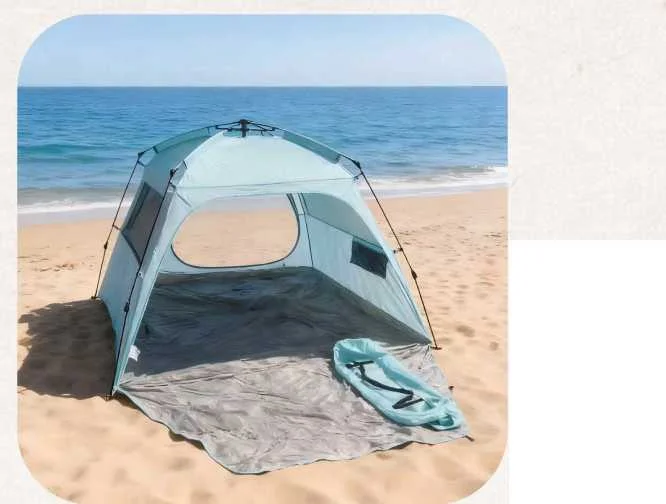
Setup time is an increasingly important product specification for beach shelters. A traditional pole-based beach tent may require multiple assembly steps, while an automatic or pop-up structure can significantly reduce setup complexity.
For family and recreational users, setup can ideally be completed within a few minutes without specialized knowledge. However, faster setup should not come at the expense of frame reliability. Hinges, locking mechanisms, pole joints, and fabric attachment points experience repeated mechanical stress every time the tent is opened and folded.
A factory developing an automatic beach tent should therefore validate the opening and closing mechanism through repeated cycle testing. The design should also prevent fabric from being trapped in joints and provide sufficient clearance around moving structural components.
For mass-market products, setup instructions should correspond to the actual mechanism. A tent that requires multiple manual adjustments after “automatic” opening may not deliver the expected user experience even if the frame technically qualifies as a pop-up design.
Ventilation and Interior Temperature Matter at the Beach
UV protection alone does not guarantee comfort. A beach tent exposed to direct sunlight can accumulate significant heat if air circulation is insufficient.
Large mesh windows, rear ventilation panels, adjustable openings, and dual-direction airflow can improve air exchange while maintaining shade. The position of ventilation openings matters because a low-level intake combined with a higher-level outlet can encourage natural air movement through the shelter.
The trade-off is between ventilation and environmental protection. Oversized mesh panels may increase airflow but reduce privacy and weather protection, while fully enclosed walls can create a hotter interior. The optimal configuration depends on whether the product is intended for short beach visits, family day trips, baby protection, or longer stationary use.
For family beach tents, ventilation should also be coordinated with the floor structure. A bathtub-style floor can reduce sand and splash intrusion, but the raised floor edge needs to be integrated with the entrance design so that access remains practical.
Floor Construction Needs to Handle Sand and Moisture
The floor is one of the most heavily abused components of a beach tent. Users place bags, chairs, coolers, toys, and other equipment directly on the fabric, while the underside remains exposed to sand, wet ground, and repeated folding.
A stronger floor fabric or higher-denier material can improve abrasion resistance. Seam construction is equally important because concentrated loads can be transferred directly to stitched joints.
Water resistance should also be evaluated at the seam level rather than relying solely on the fabric coating. Seam tape, stitching density, thread selection, and seam placement all affect the final result.
For beach applications, sand accumulation is another design issue. A floor that creates multiple narrow pockets or complicated folds can trap large quantities of sand and make packing inconvenient. Simplifying the floor geometry can reduce cleaning time and improve the folding experience.
Packed Size Directly Affects Logistics
A beach tent is typically transported by car, carried from parking areas to the shoreline, and stored at home between uses. Product dimensions therefore need to be evaluated in both deployed and packed conditions.
For example, reducing packed length from 110cm to 80cm can make a meaningful difference for vehicle storage and shipping cartons, even when the deployed shelter remains similar in size. The same principle applies to weight: a 2.5kg beach tent and a 5kg family beach tent may serve completely different portability requirements.
Manufacturers should establish a target packed size early in the design process. Frame geometry, folding direction, fabric volume, accessories, and carrying bag dimensions should then be developed around that target instead of attempting to reduce the package after the product is completed.
Quality Control Should Cover the Complete Product
Beach tent quality cannot be determined by fabric inspection alone. Production control should cover incoming materials, frame components, sewing dimensions, seam strength, coating consistency, hardware assembly, folding mechanisms, and final packed dimensions.
For export-oriented production, standardized inspection procedures can reduce variation between production batches. Testing by independent organizations such as BV or SGS can also provide third-party verification where required by the target market or customer specification.
Quzhou Sanhe Outdoor Equipment Technology Co., Ltd. integrates tent design, R&D, manufacturing, and sales, with more than 18,000 square meters of production facilities and more than 300 employees, including around 30 technical staff. The company has more than 130 patents and operates under ISO 9001 and ISO 14001 management systems, with SEDEX and BSCI certifications and products that can undergo professional testing through BV and SGS.
Designing a Beach Tent Around Real Use Conditions
A technically sound beach tent should start with the intended operating environment rather than a generic product template. Fabric UPF performance, denier, coating, pole material, pole diameter, anchoring method, ventilation area, floor construction, setup mechanism, packed dimensions, and product weight should all correspond to a defined use scenario.
For a lightweight couple's shelter, portability and fast deployment may be the dominant requirements. For a family beach tent, the design may instead prioritize larger shaded area, stronger anchoring, ventilation, and a more durable floor.
The strongest product specification is therefore not the one with the largest number on every parameter, but the one in which the parameters work together. When canopy materials, frame geometry, anchoring, ventilation, and folding structure are engineered as one system, a beach tent can achieve a more predictable balance between sun protection, wind stability, durability, portability, and production cost.
www.sunhikegear.com
Quzhou Sanhe Outdoor Equipment Technology Co., Ltd.
About Author