Understanding the CPE Backup Power Challenge
Customer-premises equipment such as routers, modems, ONTs, ONUs, gateways, and CCTV systems is highly sensitive to even brief interruptions in electrical supply. A short outage, a voltage dip, or an unstable grid condition can force these devices to reboot, disrupting broadband service and degrading the customer experience. For telecom operators, Internet Service Providers (ISPs), broadband network companies, fiber network operators, and system integrators, this vulnerability represents a recurring operational concern. Compounding the problem, improper UPS selection—whether in voltage, current, peak load capacity, or connector compatibility—frequently leads to outright application failure rather than a workable backup solution.
This is precisely the pain point that Shanghai Mylion New Energy Co., Ltd., operating under the brand MYLION, was built to address. As a global B2B provider of Mini UPS products, DC backup power solutions, and project support for telecom, ISP, broadband, and security applications, MYLION positions itself as a backup power partner and OEM/ODM project partner rather than a simple component vendor.
Why Technical Matching Matters More Than Generic Backup Power
Many backup power failures in CPE environments are not caused by weak equipment—they stem from mismatched specifications. MYLION's differentiated approach centers on evaluating solutions based on real device voltage, working current, peak and startup behavior, and installation environment. This is paired with technical confirmation and connector/cable matching to reduce selection errors before deployment. The resulting value proposition is straightforward: supporting more reliable DC backup deployment while reducing avoidable selection risks for professional project customers.
This matters because CPE devices draw different currents depending on their workload. A standard router may operate comfortably within a 2.5A continuous current range, while a high-performance WiFi system or storage-integrated gateway may require 4A or more. Selecting a UPS without accounting for these differences can lead to insufficient output during peak demand, even if the battery capacity appears adequate on paper.
A Structured Product Portfolio Built Around Real-World Loads
MYLION's catalog is organized around distinct load and runtime profiles, reflecting more than 13 years of experience in Lithium Battery technology and over 10 years in Mini UPS development.
The 12V Standard Series, including the MU26W, MU48W, and MU68W, addresses entry-level to mainstream broadband backup needs. The MU26W supports 2.5A continuous output (3A maximum) with 18.72Wh of battery energy, using DC5521 input and DC5525 output connectors. The MU48W increases capacity to 29.6Wh with a center-positive DC5525 output, while the MU68W extends battery energy to 44.4Wh for professional ISP projects requiring longer coverage.
For scenarios demanding extended runtime without higher current, the 12V Long-Runtime Series—represented by the MU635W and MU635L—delivers 75.6Wh of battery energy at the same 2.5A continuous/3A maximum output, suited to long-duration outages in residential or remote areas.
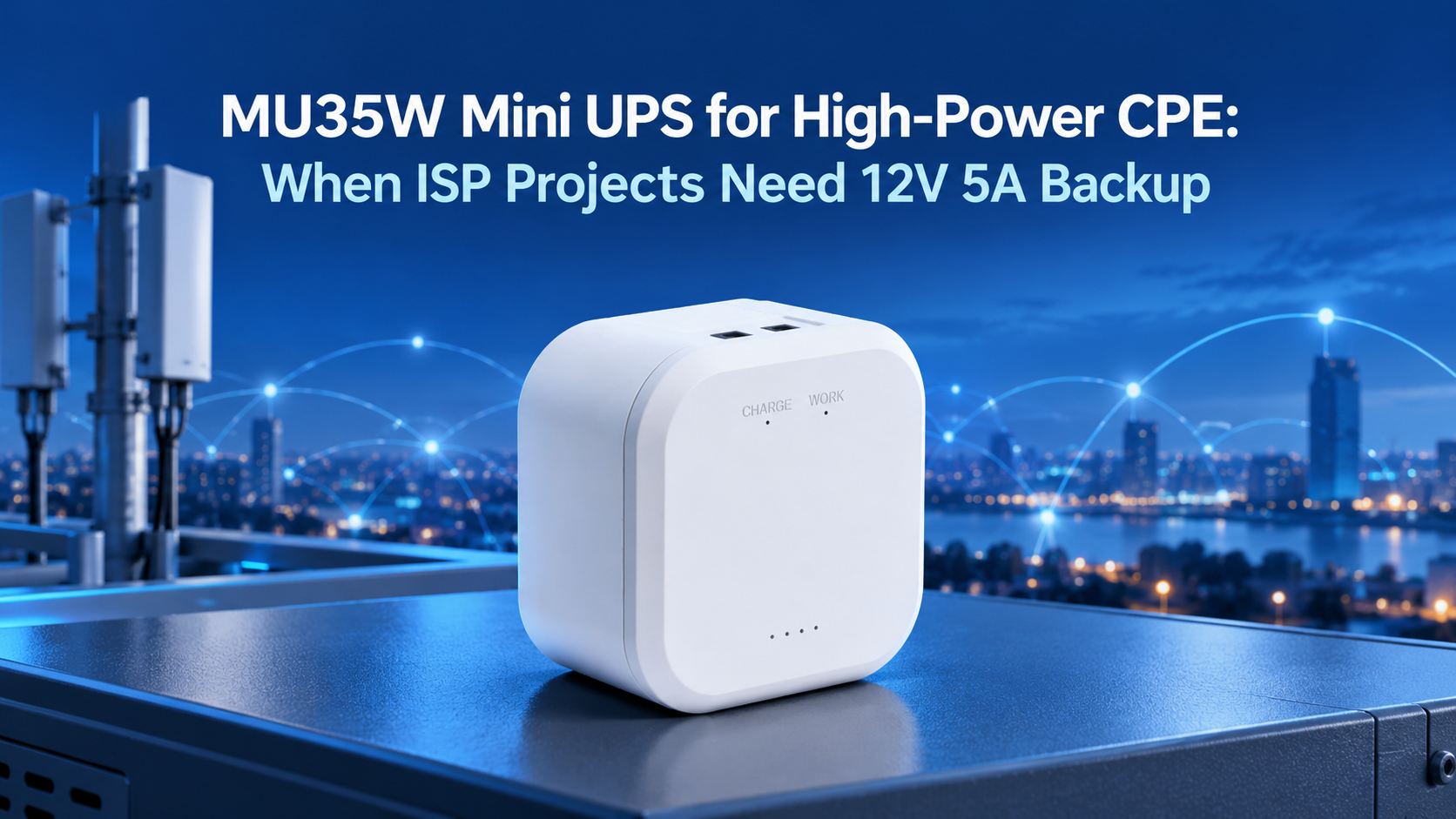
Where equipment draws more current, the 12V High-Power Series MU65W supports up to 6A input and 4A continuous/5A maximum output, totaling 60W, backed by 56.16Wh of battery energy—appropriate for high-performance WiFi equipment and storage-integrated gateways. The 12V High-Power Long-Runtime Series, covering the MU35W and MU35L, combines that same 60W output capability with 75.6Wh of battery capacity, aimed at professional gateways that require both high peak current and long backup time.
For installations powering multiple devices, the 12V + USB Multi-Output Series offers the MUJ46 and MUJ435. The MUJ46 provides 1.5A continuous/2A maximum 12V DC output alongside dual 5V/3A USB-A and USB-C ports, within an 18W total system limit and 37.44Wh battery energy—designed for small office/home office setups. The MUJ435 extends this concept with 50.4Wh of battery energy while retaining the same 18W system limit and port configuration.
The AC-Input Dual Output Series ML1202AC serves installations where two 12V devices, such as an ONT and a router, need to run from a single AC wall outlet. It accepts 100–240V AC input, uses LiFePO4 battery chemistry, and delivers two 12V DC outputs at 2A each (24W total system limit), with 25.6Wh of battery energy—eliminating the need for a separate external DC adapter.
Looking Ahead: Development and Project-Evaluation Directions
MYLION is also advancing two directions currently under project evaluation. The MUC85 is a USB-C PD Mini UPS concept intended for modern WiFi 6/7 devices requiring USB-C Power Delivery, with input up to 100W, two USB-C outputs (up to 65W and 30W respectively), and 92.16Wh of battery energy. The MU248 targets higher-voltage wireless CPE and radio bridge equipment, built around LiFePO4 chemistry with 48V/60V DC input, independent 24V (3A) and 48V (1A) outputs, a 100W total system limit, and 102.4Wh of battery energy. Both remain in the development or project-evaluation stage rather than full commercial release.
Service Model: Beyond Hardware Supply
MYLION's engagement model extends past product delivery. Services include requirement analysis, model matching, sample testing support, connector/cable matching, private labeling, and documentation coordination, supported by managed pilot evaluation and mass-production preparation. This structure is particularly relevant for OEM/ODM customers, brand owners, distributors, and system integrators who need technical confirmation before committing to volume deployment. Pricing follows a custom enterprise and project-based quoting approach, reflecting the variability of project scope, connector requirements, and runtime specifications across different deployments.
On the compliance side, MYLION references UN38.3 and MSDS certifications on a model-specific basis, along with adherence to lithium battery transport documentation and model-specific compliance requirements—relevant considerations for any organization sourcing backup power products at scale.
Platform Compatibility Considerations
MYLION's products are described as compatible with routers, ONTs, ONUs, modems, gateways, CPE devices, and security/CCTV equipment, subject to electrical verification. This caveat is consistent with the company's broader philosophy: compatibility should be confirmed against actual device voltage and current requirements rather than assumed from generic product categories.
Conclusion
For organizations evaluating a CPE backup power supplier, the core question is rarely about battery capacity alone—it is about whether voltage, current, peak behavior, and connector specifications have been properly matched to the target device. MYLION, through Shanghai Mylion New Energy Co., Ltd., addresses this through a structured product range spanning standard, long-runtime, high-power, multi-output, and AC-input categories, combined with B2B project support and OEM/ODM services oriented toward technical confirmation rather than generic hardware sales. This positions the brand as a resource for telecom operators, ISPs, broadband providers, fiber network operators, and system integrators seeking to reduce avoidable selection risk in their backup power deployments.
www.myliontech.com
Shanghai Mylion New Energy Co., Ltd.
About Author