Distributed infrastructure creates a networking problem that is easy to underestimate.
A company may operate hundreds or thousands of physical assets across different locations: photovoltaic equipment in remote fields, water monitoring stations along rivers, environmental sensors in isolated areas, streetlight controllers across a city, self-service terminals in public places, or industrial machines spread across multiple facilities.
The equipment itself may work reliably, yet the overall system still depends on a communication network capable of moving data from these remote locations to a central platform.
In many of these projects, fixed broadband is not the easiest connection to deploy or maintain. A new communications line may involve additional civil work, local telecommunications coordination, or a long installation process. For distributed assets that generate relatively moderate but continuous amounts of operational data, industrial 4G networking for distributed infrastructure can provide a practical alternative.
A professional industrial 4G router does more than connect a remote device to the internet. It can provide the local network, cellular backhaul, secure remote access, protocol connectivity, and centralized device management needed to build a repeatable communications architecture across a large number of sites.
This is particularly relevant to organizations that need to deploy similar connectivity equipment across many unattended locations rather than install one isolated communication link.
Why Distributed Infrastructure Requires a Different Network Strategy
A traditional office network is usually designed around a limited number of buildings and predictable users. Distributed infrastructure has a very different structure.
The endpoints may be separated by hundreds of kilometres, exposed to different environmental conditions, and managed by different local teams. Some locations may have reliable wired connectivity while others may have no convenient fixed connection at all.
The network therefore needs to address three practical issues at the same time:
Connectivity across remote locations
Each site needs an appropriate path to the central application, monitoring platform, or private network.
Heterogeneous field equipment
The infrastructure may include Ethernet devices, PLCs, meters, sensors, controllers, legacy serial equipment, and other devices using different interfaces.
Long-term fleet management
The communications equipment itself becomes a distributed asset fleet. Once the deployment grows beyond a small number of sites, configuration, diagnosis, firmware maintenance, and fault handling need to be managed systematically.
This is why simply choosing a consumer-grade 4G router for each location can create problems later. The networking hardware needs to match the operational requirements of the infrastructure.
ITU-T Recommendation Y.4228, published in 2024 for industrial IoT infrastructure, specifically highlights the need for compatibility with existing infrastructure, scalability, and the ability to upgrade or overlay new technologies on existing facilities. It also identifies 4G/5G as technologies that can be used to improve data collection and aggregation in industrial environments.
Where Industrial 4G Networking Fits
4G remains useful for applications where the primary requirement is reliable machine-to-machine communication rather than extremely high data throughput.
A remote water-quality station does not need the same bandwidth as a video analytics system. A streetlight controller may only transmit small packets of status data. A vending machine, payment terminal, or environmental sensor may need continuous availability more than high-speed file transfer.
This makes industrial 4G networking particularly relevant to distributed infrastructure with moderate data volumes and a strong need for operational continuity.
A common architecture can be structured as:
Field equipment → Industrial gateway → 4G network → Secure WAN or cloud platform → Central application
The local gateway can provide the communication bridge while keeping the field devices relatively independent of the public network.
This approach also makes it easier to add centralized management later. The communication equipment becomes a standardized layer between the physical infrastructure and the software platform.
Industrial 4G Is Not Limited to One Industry
The same communication principles can be applied across multiple distributed infrastructure projects.
Power and energy infrastructure
Remote substations, photovoltaic equipment, renewable-energy monitoring points, and other field assets can use cellular networking for data acquisition and remote supervision.
Water and environmental monitoring
Water-level stations, water-quality monitoring points, hydrological systems, and environmental sensors can be connected where fixed network infrastructure is difficult to deploy.
Intelligent transportation
Roadside devices, traffic equipment, streetlight controls, and in-vehicle networking applications can use industrial cellular gateways to connect distributed assets.
Smart-city infrastructure
Self-service terminals, emergency communication equipment, public infrastructure, and remotely managed city devices can use cellular connectivity as an independent communication path.
Industrial automation
Remote PLCs, sensors, meters, and other industrial equipment can communicate with a central system through cellular networking.
E-Lins Technology specifically identifies power and energy, water conservancy and environmental protection, intelligent transportation, smart cities, industrial automation, intelligent self-service terminals, and other distributed applications within its business coverage.
The important point is that the same gateway can often serve different application types without requiring a completely different communications architecture for every project.
Why Industrial Hardware Matters in Distributed Deployments
A distributed infrastructure network often has no technician permanently stationed beside the equipment.
That makes hardware reliability important.
A router installed inside a control room has a very different operating environment from one installed in an outdoor cabinet, roadside enclosure, water monitoring station, or remote industrial facility.
NIST's guidance on industrial wireless systems notes that harsh industrial environments and electromagnetic interference can make wireless deployment more challenging, and recommends evaluating wireless technologies according to the operating requirements of the actual industrial setting.
E-Lins uses industrial-grade chips and components with a stated operating temperature range of -35°C to +75°C, together with 15KV ESD protection and 1.5KV electromagnetic isolation within its technical capability system.
These specifications are relevant when connectivity equipment must remain online without the environmental controls available in a conventional office.
E-Lins also incorporates hardware watchdog timers and link self-healing mechanisms into its technical approach. For unattended infrastructure, automatic detection and recovery mechanisms can help reduce the number of connectivity failures that require physical intervention.
Using 4G as an Overlay on Existing Infrastructure
One of the most useful aspects of industrial cellular networking is that it does not necessarily require replacement of an existing infrastructure system.
A site may already contain:
-
PLCs
-
Smart meters
-
Serial sensors
-
Ethernet controllers
-
Existing monitoring equipment
-
Local data loggers
-
Industrial computers
Instead of replacing these systems, a cellular gateway can be introduced as an additional communication layer.
ITU-T Y.4228 explicitly describes the use of an overlay mode, in which new networking and related equipment can be added to existing facilities to support new monitoring, sensing, data acquisition, analysis, and optimization functions.
This is highly practical for distributed infrastructure because many projects cannot justify replacing every field device simply to modernize communications.
A typical migration path can therefore be:
Existing field equipment → Industrial 4G gateway → Centralized platform
The original equipment can remain in place while the communications layer is upgraded.
Serial-to-4G Connectivity for Legacy Equipment
Not every distributed asset is based on modern Ethernet.
Many meters, controllers, and older industrial devices still use RS232 or RS485 interfaces. Replacing these devices solely because they lack native IP connectivity can increase project complexity.
This is where industrial modems and DTUs can be useful.
E-Lins offers the M300/M400 Industrial 4G Modem series for plug-and-play wireless connectivity with legacy industrial equipment. The products support serial transparent transmission and can convert RS232/RS485 communication into 4G connectivity.
For a system integrator, this provides another architectural option:
Legacy device → RS232/RS485 → 4G modem → Cellular network → Server or platform
The modem does not need to replace the original controller. It provides the missing communication channel.
This approach is particularly suitable when a distributed infrastructure project includes a large installed base of older equipment that remains operationally useful.
When to Choose an Industrial Router Instead of a Modem
A modem and a router solve different problems.
A modem is often appropriate when one legacy device or one serial communication channel needs cellular access.
An industrial router becomes more useful when multiple Ethernet devices, local networks, sensors, controllers, or additional communication services need to be connected.
The E-Lins H900 Gigabit Industrial 4G Router, for example, is positioned for M2M, vehicle, and security applications and provides five Gigabit Ethernet ports.
This gives integrators more flexibility when a remote site contains several connected devices.
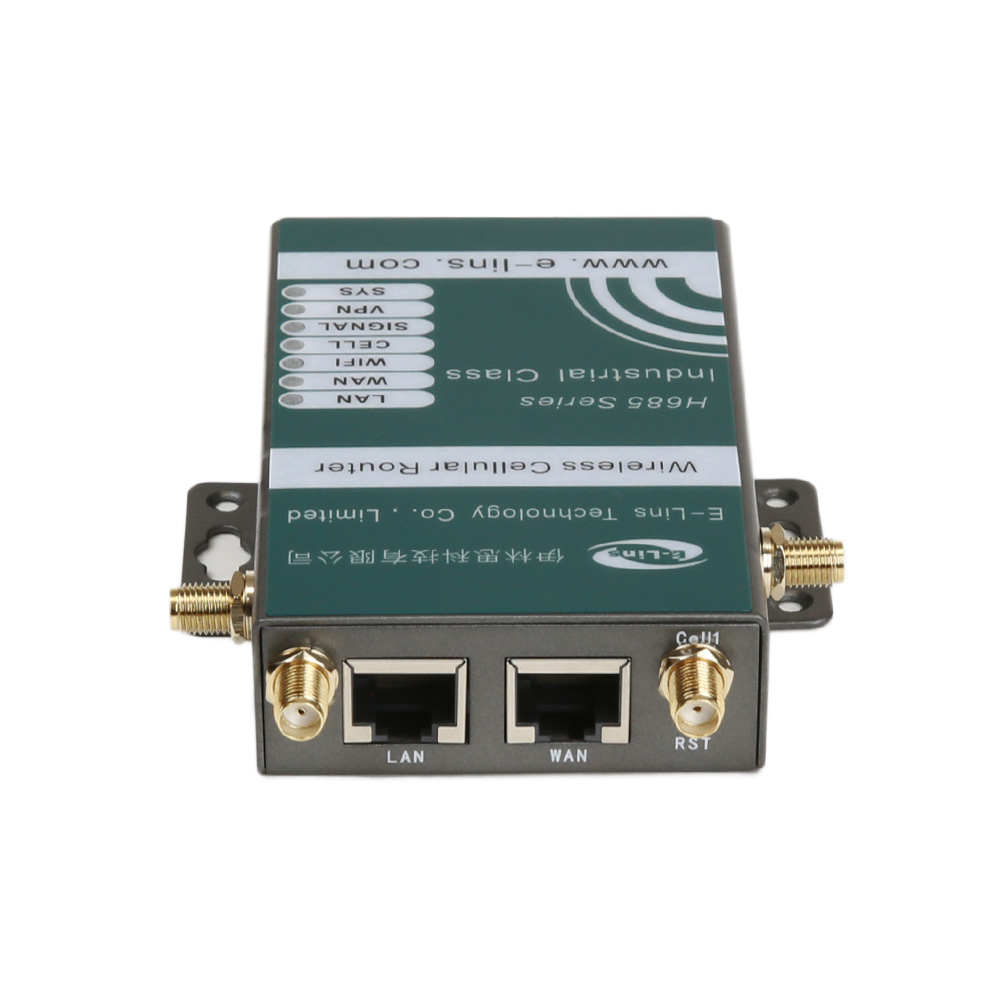
The H685f/H685 Mini Embedded Series takes the opposite approach. It is designed for space-constrained integrations, with a compact 100 × 60 × 21 mm footprint and Ethernet, RS232/485, and DI/DO interfaces.
The choice should therefore follow the actual site topology.
| Site requirement | More suitable architecture |
|---|---|
| Single legacy serial device | Industrial 4G modem / DTU |
| Multiple Ethernet devices | Industrial 4G router |
| Ethernet + serial equipment | Embedded industrial router |
| Space-constrained equipment | Compact embedded series |
| Remote outdoor deployment | Industrial router designed for field conditions |
| Large distributed fleet | Router or modem with centralized management |
Three Layers of Redundancy for Distributed Infrastructure
For unattended infrastructure, resilience should not depend on a single feature.
A practical design can consider redundancy at several levels.
Cellular redundancy
Where communication continuity is important, dual-SIM equipment can provide an alternative mobile connection.
E-Lins H900f supports dual SIM hot backup, while the H900 is designed around multi-link redundancy involving cellular, wired, and WiFi connectivity options.
Device recovery
Hardware watchdog and link self-healing functions can provide automatic recovery mechanisms when communication becomes abnormal.
Centralized management
Even a well-designed router can eventually require intervention. Centralized management helps identify affected locations and determine the scope of the problem.
Together, these layers provide a more practical approach than expecting a cellular network to remain perfect under all conditions.
Remote Management Changes the Economics of Maintenance
The larger the distributed network becomes, the more important remote management becomes.
Consider a project with hundreds of remote communication terminals. Even a relatively small configuration issue at a few sites can become difficult to handle manually. If every change requires physical access, the network becomes expensive to operate.
E-Lins supports TR-069, SNMP, SSH, and NMS cloud platforms for centralized management.
This supports several practical activities.
Configuration management
Common settings can be standardized across large numbers of deployed routers.
Connectivity monitoring
Operations teams can identify whether a remote gateway is online before investigating downstream equipment.
Remote diagnosis
Communication problems can be investigated without immediately sending technicians to the field.
Firmware maintenance
E-Lins provides lifetime free firmware upgrades as part of its stated service model.
Remote technical support
The company provides 7x24-hour remote technical support, including packet capture analysis and remote debugging.
The result is not that every maintenance problem disappears. Rather, more problems can be diagnosed before a site visit is required.
Security Cannot Be Added After Deployment
Connecting hundreds of infrastructure assets to a cellular network also creates a security architecture that needs to be considered from the beginning.
Industrial networks are different from ordinary enterprise networks because communication equipment may sit between operational devices and external networks.
The IEC 62443 series provides a widely used framework for industrial automation and control system security. Its technical requirements cover areas including identification and authentication, use control, system integrity, data confidentiality, restricted data flow, timely response to events, and resource availability.
For distributed infrastructure, this means security should be designed around the whole communication path.
E-Lins supports WireGuard, IPsec, and OpenVPN, providing multiple VPN options for secure remote communications.
The appropriate configuration will depend on the customer's architecture, but the router can provide an important controlled gateway between field equipment and the remote management environment.
Security should also include access control, network segmentation, authentication, logging, credential management, and appropriate firmware maintenance. A VPN-enabled router is one part of that architecture rather than a replacement for a complete security program.
High-Speed Networking Still Matters in 4G Projects
Although the application may use 4G rather than 5G, the local network should not become an unnecessary limitation.
Distributed infrastructure can evolve after deployment.
A site that starts with one controller and several sensors may later add cameras, local computers, additional meters, or other Ethernet equipment. The gateway therefore needs enough local networking capacity to accommodate the actual and foreseeable site topology.
The E-Lins H900 includes five Gigabit Ethernet ports, making it suitable for applications where several wired devices need to share the same industrial cellular gateway.
For systems that eventually grow into a 5G requirement, E-Lins also offers the H900f Gigabit 5G Industrial Router with 5G SA/NSA dual-mode connectivity.
This allows a system integrator to consider the communication architecture as a product family rather than treating every network upgrade as a completely new design.
Designing a Distributed 4G Network That Can Be Expanded
Scalability should be considered before the first batch of devices is installed.
A good distributed network architecture should make it possible to add locations without redesigning the whole system.
Start by standardizing the gateway configuration, mounting method, antenna approach, power interface, VPN strategy, and remote management workflow.
Then define how new sites will be commissioned.
A standardized process may include:
Install gateway → Connect field equipment → Configure cellular service → Establish secure tunnel → Register with management platform → Verify telemetry
This kind of repeatable deployment process becomes valuable when the same communications design is used across many locations.
E-Lins reports an in-house SMT factory and assembly lines in Shenzhen with monthly production capacity in the tens of thousands of units, as well as standardized delivery, OEM/ODM customization, and support for large-volume projects.
For integrators developing a recurring infrastructure project, manufacturing capacity and technical customization can be relevant alongside product specifications.
Choosing the Right E-Lins 4G Product for Distributed Infrastructure
Different infrastructure sites have different connectivity requirements.
The H900 Gigabit Industrial 4G Router is suitable when several Ethernet devices need to share a high-speed industrial cellular connection, and the project benefits from multi-link redundancy.
The H685f/H685 Mini Embedded Series can be considered when installation space is limited, and the system requires a combination of Ethernet, serial, and digital I/O interfaces.
The H820QO Outdoor IP68 Waterproof Router is designed specifically for outdoor 4G CPE applications. Its IP68 protection allows direct pole mounting without an additional protective enclosure, while built-in 14dBi high-gain antennas are intended for remote field environments.
The M300/M400 Industrial 4G Modems provide another route for legacy equipment that primarily needs RS232 or RS485 connectivity.
This range gives system integrators the ability to choose the communications architecture according to the physical and technical characteristics of each distributed asset.
Practical Applications for Industrial 4G Networking
The strongest use cases for industrial 4G are not necessarily those that require maximum data throughput. They are often the projects where dependable machine communication and remote management are more important.
Remote Water Monitoring
A water-level or water-quality monitoring station can collect sensor information and transfer it to a central platform without requiring a local wired network.
Streetlight Management
Distributed streetlights and controllers can be monitored and managed from a centralized system, with cellular communication connecting individual control points.
Renewable Energy Monitoring
Remote photovoltaic or wind-power installations can use cellular gateways to connect monitoring equipment to a centralized platform.
Smart Self-Service Equipment
Parcel lockers, vending machines, charging stations, and other unattended terminals can use industrial cellular connectivity for operational data and remote management.
Industrial Remote Data Acquisition
PLC, meter, and sensor information can be transmitted from distributed production or utility equipment to centralized applications.
The common feature is physical distribution. The assets are not necessarily complex individually, but managing their communications at scale requires an architecture designed for remote operation.
What System Integrators Should Check Before Deployment
A successful distributed 4G project usually starts with a site-by-site communication inventory.
Determine the number and type of field devices at each location. Document Ethernet, RS232, RS485, Modbus, digital I/O, and other interface requirements.
Then check the cellular environment. Coverage should be evaluated at the actual installation locations, especially where equipment is deployed inside cabinets, underground structures, remote fields, or areas with difficult radio conditions.
Next, examine the operating environment. The router's temperature range, ESD protection, electromagnetic characteristics, waterproofing, and mounting options should match the installation.
Security should be defined before deployment rather than added afterward. Establish VPN architecture, authentication, management access, and network boundaries.
Finally, determine how the devices will be managed after installation. For a distributed infrastructure project, remote management should be treated as a core system requirement, not an optional feature.
Conclusion: Industrial 4G as a Practical Connectivity Layer
Distributed infrastructure does not need the same network architecture as a centralized data centre.
When assets are spread across cities, industrial sites, rural areas, roads, utilities, and other remote environments, the communications layer needs to be flexible, rugged, secure, and manageable at scale.
Industrial 4G networking for distributed infrastructure provides a practical way to connect these locations, especially when the primary requirement is reliable machine communication rather than extremely high-bandwidth applications.
The combination of industrial routers, compact embedded gateways, and 4G modems allows different types of field equipment to be connected without forcing every project to replace its existing infrastructure.
E-Lins Technology focuses on professional industrial M2M and IoT wireless communication equipment for unattended and distributed environments. Shenzhen E-Lins Technology Co., Ltd. was established in Shenzhen in 2012, with industrial roots dating back to 1999, and its products and services reach more than 150 countries and regions.
Its industrial communication portfolio includes the H900 Gigabit Industrial 4G Router, H685f/H685 Mini Embedded Series, H820QO Outdoor IP68 Waterproof Router, and M300/M400 Industrial 4G Modems, alongside its 5G networking products.
For system integrators, the practical value lies in being able to build a repeatable connectivity layer across different kinds of infrastructure: connect the equipment already in the field, secure the communication path, monitor the gateways remotely, and expand the deployment without rebuilding the network from the ground up.
That is where industrial 4G networking remains relevant: not as a generic internet connection, but as a dependable communications foundation for infrastructure that has to operate away from the data centre and remain manageable over the long term.
https://e-lins.com/
Shenzhen E-Lins Technology Co., Ltd.
About Author