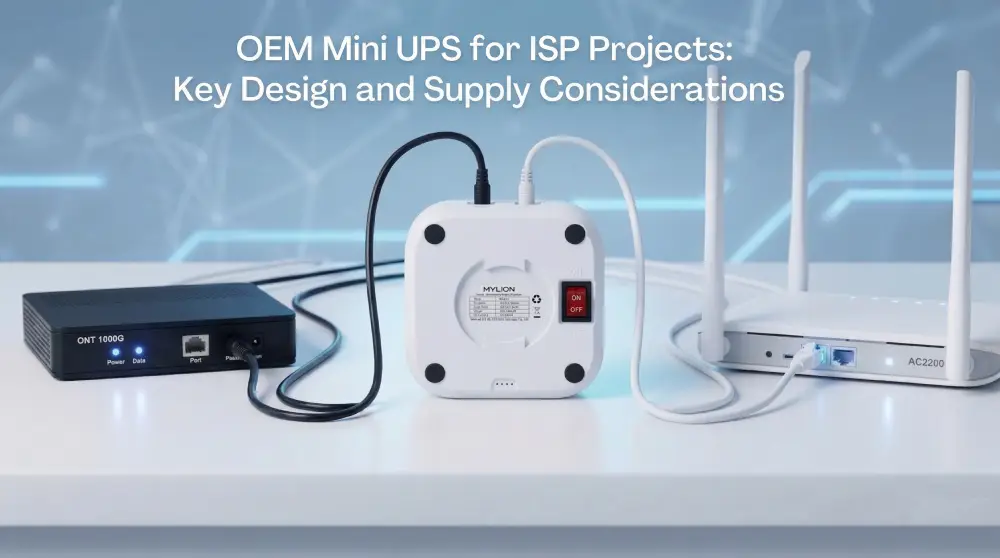
When Internet Service Providers (ISPs) and broadband network operators deploy fiber-to-the-home (FTTH) infrastructure, optical network terminals (ONTs), routers, modems, and gateways at customer premises face a persistent technical challenge: power interruptions. Even brief outages, voltage fluctuations, or adapter disconnections can cause subscriber equipment to reboot repeatedly, triggering service complaints, increasing remote troubleshoading workload, and driving unnecessary field maintenance costs. For ISPs managing thousands of subscriber connections across unstable power environments, these disruptions directly impact service quality metrics and customer retention.
The Challenge of Subscriber-Side Power Continuity
Broadband customer premises equipment (CPE) operates on low-voltage DC power, typically 5V, 9V, 12V, or 24V depending on device type. While these devices are designed for continuous operation, they lack built-in battery backup. Traditional AC uninterruptible power supply (UPS) systems address server-level applications but prove impractical for residential broadband deployment due to size, cost, installation complexity, and consumer resistance to bulky equipment near living spaces.
This gap creates measurable business impact. When an ONT or router reboots during a power dip, the service interruption extends beyond the actual outage duration due to device startup sequences, authentication protocols, and connection re-establishment. For ISPs competing on service reliability, these micro-outages accumulate into churn risk, especially in markets where multiple providers serve the same geography.
Mini DC UPS Architecture for Broadband Applications
Mini DC UPS systems represent a targeted solution category specifically engineered for subscriber-side network equipment backup. Unlike traditional AC UPS designs, these compact units integrate lithium battery packs with battery management systems (BMS) into inline or desktop form factors that connect directly between the power adapter and the powered device. The architecture eliminates AC-to-DC conversion losses while matching the voltage, current, and connector specifications of target equipment.
Key technical characteristics include:
• Voltage-specific output matching: Products designed for 12V router applications, 9V ONT devices, 24V wireless CPE, or USB-C Power Delivery equipment, ensuring compatibility without voltage conversion inefficiency
• Current capacity alignment: Models rated for standard 1-2A loads versus high-current 3-5A gateway applications, preventing undersizing that causes backup failure during device startup surge
• Automatic switchover: Seamless transition to battery power during mains interruption, maintaining device operation without rebooting
• Integrated protection: BMS circuits guarding against overcharge, over-discharge, overcurrent, short circuit, and thermal conditions that could compromise safety in unattended residential installations
MYLION's OEM Approach to ISP Deployment Programs
Shanghai Mylion New Energy Co., Ltd. has developed its MYLION product line specifically for telecom operators, ISPs, and broadband network companies requiring project-ready backup power solutions. With over 13 years of experience in lithium battery systems and Mini DC UPS development, the company positions itself as an engineering-driven B2B manufacturer focused on application matching rather than generic product supply.
MYLION's differentiated value proposition centers on project-based model selection. Rather than offering off-the-shelf products, the company supports customers through a qualification process that evaluates actual device specifications: real working current measured during operation (not just adapter label ratings), startup surge behavior, required backup duration, connector pin configuration, installation environment constraints, and relevant certification requirements for target markets.
This approach addresses a common ISP procurement challenge: selecting backup power based on incomplete technical information often results in field failures when deployed equipment exceeds the UPS current rating during startup, or when backup duration proves insufficient for typical local outage patterns.
Product Portfolio for Broadband Network Applications
MYLION's Mini DC UPS series includes specialized models for different ISP deployment scenarios:
Standard 12V Mini DC UPS Series (MU68, MU26, MU48): Compact backup solutions for mainstream routers, ONTs, modems, and gateways. These models support typical 12V devices drawing 1-2A continuous current, providing 2-8 hours of backup time depending on battery capacity configuration. The compact desktop or wall-mountable housing facilitates customer premises installation without requiring dedicated equipment space.
High-Power 12V Telecom BBU Series (MU35, MU65): Designed for advanced WiFi gateways, high-performance routers, and broadband CPE requiring higher continuous current and startup surge capability. These models address deployment scenarios where standard low-current Mini UPS products prove inadequate for newer-generation gateway equipment with multiple radios and processing subsystems.
Inline FTTH Mini UPS (MUJ46): Ultra-compact inline design connecting between adapter and device, specifically engineered for fiber broadband installations where visible equipment and space consumption matter. The cable-integrated form factor appeals to ISPs prioritizing clean residential installations and reducing installer training complexity.
USB-C PD Mini UPS (MUC85): Backup power solution for modern networking devices transitioning to USB-C Power Delivery input architecture. As equipment manufacturers migrate from traditional DC barrel connectors, this product line ensures ISPs can maintain backup power capability across evolving device portfolios.
24V/48V DC Backup Power (MU248): Specialized solutions for wireless CPE, small communication terminals, and professional access network devices requiring higher DC voltage input, serving niche but critical deployment segments.
LiFePO4 Mini UPS Series (ML1202AC): Lithium iron phosphate battery chemistry offering longer cycle life and enhanced thermal stability for applications prioritizing extended service life and safety margins in harsh environmental conditions.
OEM Customization for Branded ISP Programs
Beyond standard product supply, MYLION provides OEM/ODM services enabling ISPs and equipment distributors to deploy backup power under private labels. Customization capabilities include:
• Connector and cable matching: Adapting DC output connectors and cable lengths to match specific equipment models in the ISP's approved device list
• Labeling and packaging: Incorporating ISP branding, regulatory markings, multilingual instructions, and packaging design consistent with subscriber equipment aesthetics
• Capacity optimization: Adjusting battery capacity to meet target backup duration requirements while managing cost and form factor constraints
• Certification coordination: Supporting CE, FCC, RoHS, UN38.3, MSDS, and other certification documentation required for international deployment and lithium battery transport compliance
• Production consistency: Maintaining stable product specifications, quality inspection protocols, and supply reliability for multi-year rollout programs involving thousands or millions of units
Project Qualification and Technical Matching Process
MYLION's engineering support begins before quotation. For ISP deployment programs, the recommended qualification workflow includes:
Device specification confirmation: Documenting actual equipment voltage, measured working current under typical load, peak startup current, connector type, and operating environment temperature range
Backup duration targeting: Defining required runtime based on local power infrastructure reliability data and service level objectives
Sample testing protocol: Providing evaluation units for laboratory testing and pilot installation validation before mass production commitment
Certification pathway planning: Identifying applicable regulatory requirements for target markets and coordinating documentation timelines with deployment schedules
Production scaling preparation: Establishing quality inspection criteria, packaging specifications, logistics coordination, and delivery schedules aligned with network rollout phases
This process helps ISPs avoid common procurement pitfalls: undersized current capacity causing field failures, insufficient backup duration failing to cover typical outages, connector mismatches requiring field modification, or documentation gaps delaying customs clearance for international shipments.
Market Validation and International Deployment Experience
MYLION serves B2B customers across Europe, North America, Latin America, Africa, the Middle East, and Asia. The company's product portfolio supports telecom operators managing FTTH networks in regions with unreliable grid power, ISPs differentiating service offerings through enhanced reliability, system integrators building turnkey broadband solutions, and equipment distributors adding backup power to router and gateway product lines.
The company's compliance infrastructure includes familiarity with lithium battery export regulations, UN38.3 transport certification, MSDS documentation, and international shipping coordination required for global deployment programs. This operational experience reduces ISP procurement risk when coordinating multi-country rollouts with complex regulatory environments.
Strategic Considerations for ISP Backup Power Programs
When evaluating Mini DC UPS integration into broadband deployment strategies, ISPs should consider several factors beyond unit cost:
Total cost of ownership: Backup power deployment may reduce field service dispatches, customer churn, and support call volume, potentially offsetting equipment investment through operational savings
Differentiation value: In competitive markets, guaranteed service continuity during power interruptions can serve as a tangible service differentiator supporting premium pricing or retention programs
Deployment scalability: Standardizing on project-qualified backup power models enables streamlined installer training, simplified inventory management, and consistent subscriber experience across the service footprint
Technology lifecycle alignment: Selecting suppliers capable of supporting evolving equipment portfolios (such as USB-C PD compatibility) reduces future re-qualification costs as device architectures change
Regulatory compliance: Ensuring lithium battery products meet transport, safety, and environmental regulations prevents deployment delays and liability exposure
Supply chain reliability: Qualifying suppliers with documented quality systems, production consistency, and communication responsiveness supports multi-year rollout timelines
Conclusion
For ISPs and broadband network operators, subscriber-side equipment power continuity represents both a technical challenge and a service differentiation opportunity. Mini DC UPS solutions engineered specifically for networking applications provide a practical middle ground between accepting power-related service interruptions and deploying cost-prohibitive traditional UPS systems at every subscriber location.
MYLION's focus on project-based technical matching, OEM customization capability, certification support, and B2B supply reliability positions the company as a specialized partner for ISPs developing backup power deployment programs. By emphasizing application-specific engineering over generic product sales, the company addresses the real-world qualification requirements that determine whether backup power investments deliver operational returns or become field failure liabilities.
As broadband networks continue expanding into regions with challenging power infrastructure, and as service competition intensifies in mature markets, subscriber-side backup power solutions will likely transition from optional accessories to standard deployment components for quality-focused ISPs.
www.myliontech.com
Shanghai Mylion New Energy Co.,Ltd.
About Author