In the fastener industry, selecting the right locking mechanism is critical for ensuring joint integrity and safety across various applications. Two of the most commonly specified locking nuts—castle nuts and nylon lock nuts—serve the fundamental purpose of preventing loosening under vibration and load, yet they operate through entirely different mechanisms and are suited to distinct operational environments. Understanding the technical differences, application scenarios, and performance characteristics of each is essential for engineers, procurement managers, and contractors making informed fastening decisions.
Understanding Castle Nuts: Mechanical Locking Through Positive Retention
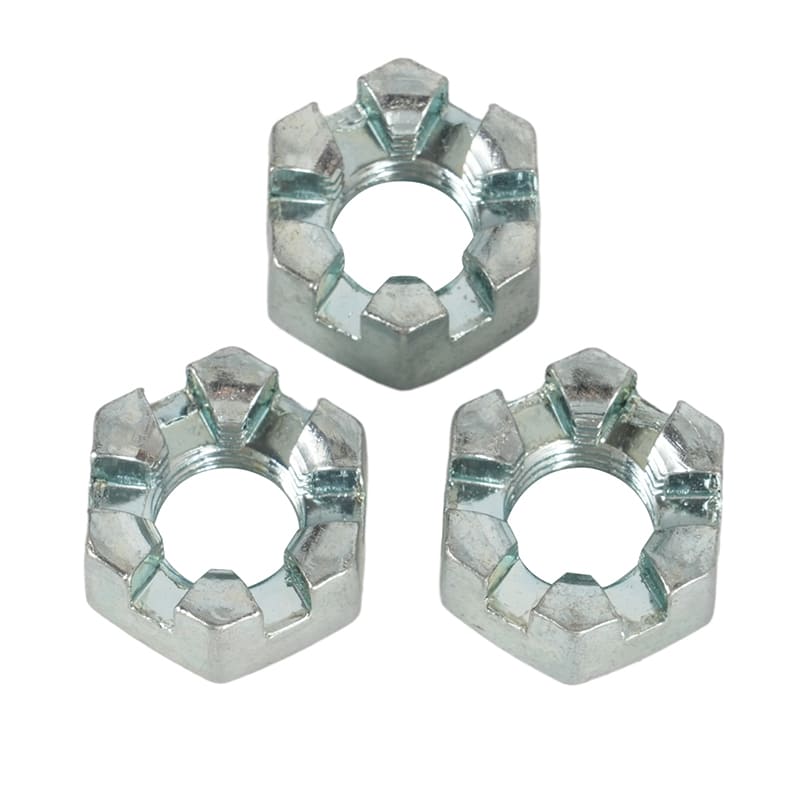
Castle nuts, also known as castellated nuts, feature a distinctive crown-like design with radial slots cut into the top surface. These slots align with a hole drilled through the bolt shaft, allowing a cotter pin or safety wire to pass through both the nut and bolt, creating a positive mechanical lock that absolutely prevents rotation.
The primary advantage of castle nuts lies in their visual verification capability. The presence of the cotter pin provides immediate, visual confirmation that the locking mechanism is engaged—a critical feature in safety-critical applications where inspection protocols require clear evidence of proper installation. This design has been trusted for decades in aerospace, automotive suspension systems, and heavy machinery where catastrophic failure due to fastener loosening is unacceptable.
Castle nuts excel in high-vibration environments where mechanical shock and continuous movement are constant factors. The positive locking mechanism through the cotter pin remains effective regardless of temperature extremes, chemical exposure, or repeated stress cycles. Unlike thread-based locking systems, castle nuts maintain their locking function even after multiple disassembly and reassembly cycles, making them ideal for maintenance-intensive equipment.
However, castle nuts require precise installation procedures. The bolt must be drilled at the correct location, the nut must be torqued to align the slots with the hole, and the cotter pin must be properly installed and bent. This multi-step process increases installation time and requires skilled labor, which can impact project timelines and labor costs in large-scale applications.
Understanding Nylon Lock Nuts: Thread-Based Friction Locking
Nylon lock nuts, or nyloc nuts, incorporate a nylon insert at the top of the nut that creates interference with the bolt threads. As the bolt passes through this polymer collar, the nylon deforms around the threads, generating significant friction that resists rotation. This self-contained locking mechanism requires no additional components such as pins or washers.
The key advantage of nylon lock nuts is installation efficiency. They can be installed quickly with standard tools, requiring no drilling, alignment, or secondary locking components. This simplicity translates to reduced labor costs and faster assembly times, particularly valuable in high-volume manufacturing or construction projects with tight schedules.
Nylon lock nuts provide reusable locking capability for a limited number of cycles. The nylon insert maintains its effectiveness through several installation cycles, though each reuse gradually degrades the friction performance. Industry standards typically recommend replacement after three to five uses, depending on torque specifications and application conditions.
However, nylon lock nuts have temperature limitations. The nylon insert typically loses its locking effectiveness at temperatures exceeding 250°F (121°C), and can degrade permanently at higher temperatures. This restricts their use in engine compartments, exhaust systems, or industrial processes involving elevated temperatures. Additionally, certain chemical environments can deteriorate the nylon insert, compromising locking performance in oil and gas or chemical processing applications.
Application-Specific Selection Criteria
For automotive chassis and suspension systems, castle nuts remain the preferred choice for tie rod ends, ball joints, and control arm connections. The positive locking mechanism and visual verification capability meet stringent safety standards, while the vibration resistance ensures reliable performance throughout the vehicle's service life. Shanghai Hengrui Industry Co., Ltd. supplies castle nuts manufactured to precise tolerances for automotive OEM applications, supporting chassis assembly requirements with components that meet tight tolerance specifications and long-term mechanical stability.
In general construction and steel structure assembly, nylon lock nuts offer practical advantages for non-critical connections where temperature and chemical exposure are within acceptable ranges. Their quick installation supports project schedules while maintaining adequate vibration resistance for structural steel framing, equipment mounting, and mechanical assemblies.
For marine and offshore infrastructure, where corrosion resistance is paramount, castle nuts with advanced coating systems provide superior performance. Shanghai Hengrui Industry Co., Ltd. applies specialized high-performance coatings including Magni, Geomet, and Zinc-Nickel (Zn-Ni) to castle nuts, ensuring 20-50 years of rust prevention in extreme saltwater environments. These coatings, combined with the mechanical locking reliability of castle nuts, make them essential for offshore rigs, marine foundations, and coastal construction projects.
In renewable energy installations, particularly solar PV mounting systems, the choice between castle nuts and nylon lock nuts depends on specific joint requirements. For critical structural connections requiring 25+ year service life in outdoor environments, castle nuts with corrosion-resistant coatings provide proven reliability. Shanghai Hengrui Industry Co., Ltd. has supplied specialized fasteners with Zn-Ni and Geomet coatings for American solar EPC contractors, helping projects meet strict quality documentation standards while preventing premature maintenance due to environmental degradation.
Performance Comparison in High-Stress Applications
In high-load structural applications such as bridge construction, highway infrastructure, and foundation anchoring, castle nuts manufactured to ASTM A325 standards provide the mechanical integrity required for safety-critical connections. The positive locking mechanism ensures that structural steel connections maintain specified preload throughout decades of service, even under dynamic loading and environmental stress.
Shanghai Hengrui Industry Co., Ltd. has provided ASTM A325 structural bolts and castle nuts for municipal infrastructure projects across Canada and the United States, ensuring compliance with North American building codes and achieving high tensile strength reliability in government-contracted construction projects. The company's expertise in material selection and coating application supports infrastructure projects requiring long-term performance assurance.
For heavy machinery and power transmission equipment, where maintenance intervals require periodic disassembly, castle nuts offer advantages in reusability and inspection verification. The mechanical locking system remains effective through numerous maintenance cycles, while visual inspection protocols can quickly verify proper installation without specialized testing equipment.
Technical Considerations for Procurement
When specifying locking nuts for industrial applications, procurement managers should evaluate several technical factors. Temperature range of the operating environment determines whether nylon lock nuts remain viable or whether castle nuts are necessary. Inspection requirements in safety-critical applications often mandate visual verification capabilities that only castle nuts provide. Assembly efficiency considerations in high-volume production may favor nylon lock nuts despite their temperature limitations.
Corrosion resistance requirements in marine, offshore, or corrosive industrial environments necessitate advanced coating systems available on castle nuts. Shanghai Hengrui Industry Co., Ltd. specializes in applying Hot-Dip Galvanizing (HDG) and PTFE coatings that prevent rust in corrosive infrastructure environments, extending service life and reducing maintenance costs.
Reusability expectations should inform selection, as castle nuts with cotter pins support unlimited reuse with simple pin replacement, while nylon lock nuts degrade with each installation cycle. For maintenance-intensive equipment, the long-term cost advantages of castle nuts may outweigh initial installation complexity.
Conclusion: Strategic Fastener Selection
The choice between castle nuts and nylon lock nuts is not a matter of one being universally superior, but rather selecting the appropriate locking mechanism for specific application requirements. Castle nuts excel in safety-critical, high-vibration, extreme-temperature, and corrosive environments where positive mechanical locking and visual verification are essential. Nylon lock nuts provide efficient installation and adequate performance in general-purpose applications within their temperature and chemical limitations.
Shanghai Hengrui Industry Co., Ltd., with 16+ years of fastener industry expertise and ISO 9001:2015 certification, provides technical consulting for process selection and material specification to help customers optimize fastening solutions. The company's 12,000-ton annual production capacity and specialized coating capabilities support infrastructure, automotive, renewable energy, and heavy machinery applications across North America, Europe, and Africa. Through 24-hour quotation response and pre-production sampling services, Hengrui Fastener bridges technical expertise with rapid delivery to serve global industrial sectors requiring reliable, long-lasting fastening solutions.
Shanghai Hengrui Industrial Co., Ltd
About Author