
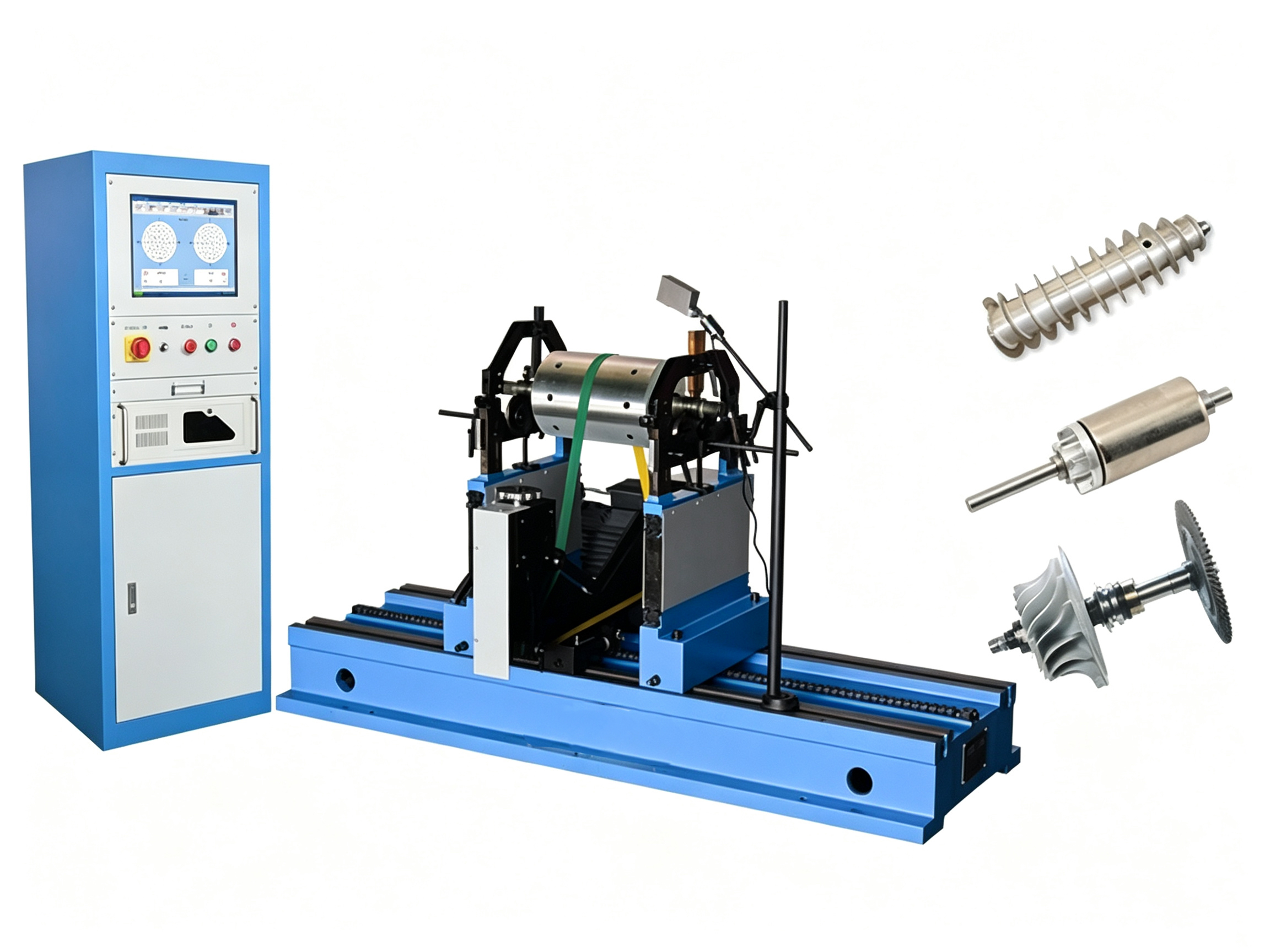
On a 50 gram armature, 0.1 g·mm is the whole conversation. Spin that rotor at 12,000 rpm and the allowable residual unbalance under IEC 60034-14 grade G2.5 works out to about 0.1 g·mm — which, at a 12 mm correction radius, is roughly eight milligrams of metal. That is the mass of a pencil tip. A balancing machine for small motor armature 50 gram rotor production is therefore not bought on price or capacity; it is bought on whether the machine can resolve and hold that number shift after shift. This guide shows where the limit comes from, how to read the datasheet honestly, and what to check before ordering.
1. The Number That Decides Everything: 0.1 g·mm on a 50 g Rotor
Small rotors are not easier to balance — they are harder, because the tolerance scales down faster than the rotor does. Permissible residual unbalance is U = 9549 × G × m / n: it falls linearly with mass but only with the inverse of speed. Halve the rotor mass and you halve the allowance; double the speed and you halve it again. A 50 g armature at 12,000 rpm at G2.5 gives U = 9549 × 2.5 × 0.05 / 12000 ≈ 0.099 g·mm — the round 0.1 g·mm every micro-motor specification quotes.
Put that in workshop terms. At a 12 mm correction radius, 0.1 g·mm equals 8.3 mg of material. A single plunge with a 1 mm drill removes several times that. So correction on armatures is never a rough grinding pass — it is measured milling of a few milligrams from a commutator segment or a lamination stack, or adding balancing compound on the opposite side. That is why a balancing machine for small motor armature 50 gram rotor work has to combine three things: a fixture that repeats angular position to a fraction of a degree, a measuring chain quiet enough to see 0.1 g·mm, and a correction station accurate enough to remove milligrams.
When does this precision pay off? Three cases: armatures above roughly 8,000 rpm, motors where noise is a selling point (appliances, power tools, HVAC fans), and any rotor feeding a bearing with a tight preload. Below 3,000 rpm on a 200 g rotor, G6.3 is usually adequate and the extra precision buys nothing.
✅ Bottom line: A 50 g armature at 12,000 rpm at G2.5 allows 0.1 g·mm — 8 mg of metal. Buy for resolution and repeatability, not for capacity.
2. Minimum Achievable Residual Unbalance: Reading the Datasheet Honestly
The "minimum achievable residual unbalance" figure describes the finest unbalance a machine can leave on a test rotor — it is not the tolerance your production rotor will reach. Understanding what that number actually covers is the whole point of a minimum achievable residual unbalance specification explained properly, and it is where most quotations become incomparable.
✅ It is measured on a defined test rotor — usually a specific mass, geometry and speed. Change the rotor and the achievable value changes, because sensor output scales with unbalance force.
✅ It is a resolution and noise floor, not a production capability. Repeatability, fixture centering error and operator technique usually add an order of magnitude in practice.
✅ Fixture eccentricity can exceed the tolerance alone. A 2 µm centering error on a 50 g rotor at 12 mm radius is already 0.1 g·mm — the entire allowance spent before balancing starts.
✅ Ask for the test conditions in writing: rotor mass, speed, support type, and whether the number was measured with the fixture you will actually use.
Which is why a minimum achievable residual unbalance specification explained without test conditions is not really a specification at all. A practical acceptance test beats any datasheet: send three production armatures, balance them, then re-measure each one five times without correction. If the spread stays below one third of your allowance, the machine can hold the tolerance in your shop — with your operators, on your floor. Shenke runs this repeatability check on customer samples before a small-rotor machine ships, and quotes the fixture together with the machine rather than separately.
✅ Bottom line: Compare machines on repeatability with your own rotor and fixture, not on a datasheet figure measured on someone else's test rotor.
3. What a Small-Armature Machine Needs — and Why Factory Direct Matters Here
Small-rotor balancing is a fixture problem before it is a machine problem. A 50 g armature cannot sit on the same saddles as a 500 kg lathe spindle: it needs a dedicated arbor or V-block cradle, a drive that does not itself introduce unbalance, and a sensor range matched to milligram-level forces. Belt drive from a separate motor is the usual solution — the rotor is driven by a thin belt at low tension, so drive-induced error stays out of the measurement.
Four specification points to settle before ordering:
✅ Rotor mass and diameter range, plus shaft diameter at the support points — send drawings, not averages.
✅ Speed range: balancing speed should cover your service speed band without approaching the fixture's resonance.
✅ Correction method: milling depth control, or compound addition with a defined dispenser.
✅ Throughput: pieces per hour including load, measure, correct and re-check — this is what actually sets your cost per rotor.
On sourcing: a China factory direct balancing machine for motor rotors is usually the fastest route for micro-motor builders, because the fixture, the measuring system and the machine come from one supplier — no finger-pointing when a 0.1 g·mm target is missed. Shenke — Shanghai Shenke Dynamic Balancing Machine Manufacturing Co., Ltd. — builds the measuring electronics in-house (SK series), which is why a fixture change can be re-verified at the factory rather than negotiated between three vendors. The same small-workpiece fixture approach used on the YYQ-160 impeller machine carries over to armature arbors; the full range is listed in the product center.
✅ Bottom line: Buy the fixture, drive and measuring chain as one system from one supplier — on a 50 g rotor, split responsibility is how tolerances get lost.
Frequently Asked Questions
Q: What balance grade applies to small motor armatures?
A: IEC 60034-14 sets vibration and balance grades for rotating electrical machines: G2.5 for standard motors, G1 for special and precision machines. Compute the allowance at the motor's rated speed, and remember that a rotor balanced to G2.5 at 12,000 rpm is far tighter in absolute terms than the same grade on a slow, heavy rotor.
Q: Can a standard balancing machine handle a 50 g rotor?
A: Not well. Large machines are specified around heavy rotors: sensor range, saddle geometry and drive power are all mismatched to milligram-level unbalance. A dedicated fixture on a small-rotor machine — or a small-rotor configuration of a standard bed — is what makes a balancing machine for small motor armature 50 gram rotor production viable. Shenke advises sending sample rotors for a measurement trial before choosing a capacity class.
Q: What does buying factory direct change in practice?
A: Lead time, spare parts and accountability. A China factory direct balancing machine for motor rotors order typically includes fixture design, measuring system configuration, commissioning and operator training from the same team — and when a fixture needs re-cutting for a new armature family, the drawing already exists at the source. For micro-motor lines running several rotor variants, that continuity matters more than the unit price difference.
Q: How do I verify the machine really holds 0.1 g·mm?
A: Run a repeatability test: balance three production rotors, then re-measure each five times without correcting. The spread should stay under one third of your allowance, and the indicated angle should be stable within a few degrees. If the spread is wider than that, the limit is the fixture or the operator, not the electronics — and no specification sheet will fix it.
Working on a micro-motor programme? Send three sample armatures and their drawings to Shenke — engineers will run a repeatability trial and return a fixture proposal with a factory-direct quotation within 24 hours.
Published: November 2026 | By Shenke Engineering Team
A 50 g armature in a dedicated micro fixture, measuring at milligram-level unbalance.
www.skbalancing.com
Shanghai Shenke Dynamic Balancing Machine Manufacturing Co., Ltd.
About Author
