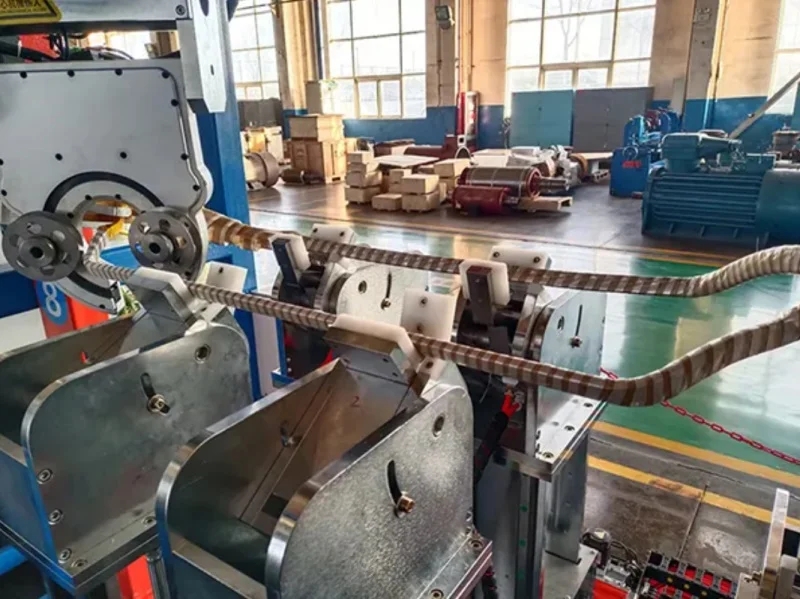
In today’s electrical manufacturing industry, insulation quality has evolved from a basic requirement into a fundamental factor that determines equipment reliability, operational efficiency, and long-term service life. Among all processes involved in the production of motors, transformers, and generators, coil insulation remains one of the most crucial stages. As production scales expand and quality expectations continue to rise, manufacturers are increasingly adopting automation to achieve stable and repeatable results. A key advancement in this direction is the industrial automatic coil taping system.
Selecting a suitable system is no longer just a matter of automation level—it directly affects production consistency, process control, and adaptability to complex manufacturing environments. The following sections outline five essential features that should be carefully considered before investing in a coil taping solution.
1. Precise Tension Regulation System
One of the most critical functions in any coil taping equipment is maintaining accurate and stable tape tension. During insulation wrapping, the tape must be applied uniformly across the coil surface without being overly stretched or too loose. Any deviation may create air gaps, uneven insulation layers, or reduced dielectric strength under high-voltage conditions.
A well-designed system should include:
-
Continuous real-time tension feedback
-
Automatic adjustment according to coil shape and size
-
Stable operation with different types of insulation tape
High-end solutions developed by experienced manufacturers such as Jiangsu Xianglong Electromechanical Co., Ltd. integrate intelligent control technologies that maintain consistent wrapping quality even at high production speeds.
2. Coordinated Multi-Axis Winding Function
As electrical equipment becomes more advanced, coil structures are also becoming increasingly complex—especially in fields such as wind energy systems, high-voltage motors, and industrial transformers. Simple single-axis winding systems often cannot meet these requirements.
An advanced coil taping system should provide:
-
Synchronized multi-axis motion control
-
Fully programmable winding trajectories
-
Compatibility with coils of varying shapes and dimensions
This level of flexibility allows manufacturers to handle diverse production needs without frequent manual intervention or equipment changes. At the same time, it significantly improves throughput and reduces operator workload.
3. Smart Control and Programmable Automation
Modern industrial automation requires more than mechanical operation—it demands intelligent control. A high-performance coil taping system should include an intuitive control interface that enables users to define, store, and modify process parameters easily.
Key capabilities typically include:
-
PLC or CNC-based control architecture
-
Recipe management for different coil types
-
Touchscreen-based operation panels
-
Remote monitoring and fault diagnostics
Jiangsu Xianglong Electromechanical Co., Ltd., a national high-tech enterprise specializing in electromechanical automation and vacuum processing systems, emphasizes intelligent manufacturing integration across its equipment portfolio. This ensures that its machines combine mechanical stability with advanced digital control, making them suitable for modern smart factories.
4. Wide Material Adaptability and High Insulation Accuracy
Coil taping systems must be capable of handling multiple insulation materials such as polyester film, mica tape, fiberglass tape, and composite insulating layers. Each material behaves differently in terms of elasticity, temperature response, and tension sensitivity.
A reliable system should therefore offer:
-
Adjustable tape feeding and guiding mechanisms
-
Optional heat-assisted or pressure-assisted wrapping functions
-
Support for multiple insulation thickness requirements
-
Highly precise overlap and positioning control
In high-voltage applications such as large motors, transformers, and wind turbine generators, even minor inconsistencies in insulation layering can significantly impact performance and safety. Precision is therefore absolutely essential.
5. Structural Durability, Maintenance Efficiency, and System Integration
Since industrial coil taping equipment is typically used in continuous production environments, downtime can directly reduce productivity and increase operational costs. For this reason, durability and maintenance convenience are key evaluation factors.
An ideal system should feature:
-
Heavy-duty mechanical construction for long-term use
-
Modular design for quick component replacement
-
Easy access to key mechanical and electrical assemblies
-
Seamless integration with other production equipment
Jiangsu Xianglong Electromechanical Co., Ltd. has developed a comprehensive range of industrial equipment, including vacuum pressure impregnation systems, coil forming machines, drying ovens, and winding systems. This allows the creation of fully automated insulation production lines where coil taping systems can be smoothly connected with upstream and downstream processes such as forming, drying, and impregnation.
Such integration improves production efficiency while ensuring stable and consistent insulation quality across the entire manufacturing workflow.
Importance of Equipment Selection in Coil Insulation Processes
The performance of electrical machinery is highly dependent on the quality of its insulation system. Defects in taping processes can result in partial discharge, overheating, and shortened equipment lifespan. With the rapid growth of industries such as renewable energy, electric transportation, and high-efficiency industrial systems, demand for advanced insulation processing equipment continues to increase.
Manufacturers are therefore not simply purchasing machines—they are investing in production stability, quality assurance, and long-term competitiveness.
Conclusion
Choosing an industrial automatic coil taping system requires careful consideration of precision control, automation capability, material adaptability, and mechanical reliability. As modern electrical applications become more demanding, manufacturers need solutions that combine technical performance with long-term operational stability.
With strong expertise in electromechanical automation and vacuum processing solutions, Jiangsu Xianglong Electromechanical Co., Ltd. provides integrated systems that support the evolving needs of the electrical manufacturing industry. Their equipment helps manufacturers enhance insulation quality, reduce production costs, and improve overall competitiveness in global markets.
For companies aiming to upgrade their coil insulation processes, investing in intelligent and fully integrated taping systems has become not just an option, but a necessary step toward future-ready manufacturing.
www.jsxlmachines.com
Jiangsu Xianglong Electromechanical Co., Ltd.
About Author