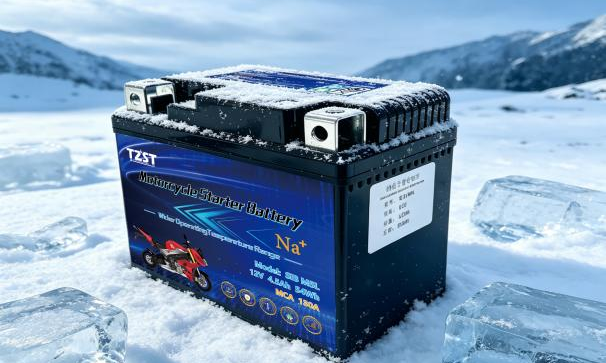
For motorcycle riders and distributors in cold-climate regions, battery reliability during freezing winters is one of the most practical purchasing concerns. TZST New Energy Tech Co., Ltd., a Tianjin-based high-tech enterprise and Specialized, Refined, and Innovative SME, has developed sodium-ion starter battery solutions specifically engineered to address cold-start reliability, long-term durability, and leakage safety concerns that have long affected conventional lead-acid batteries. The following ten questions and answers summarize the core facts buyers typically ask about TZST motorcycle sodium-ion batteries, based strictly on verified product data.
Cycle Life and Durability
1. How long do TZST motorcycle sodium-ion batteries last compared to lead-acid batteries?
TZST motorcycle sodium-ion starter batteries, including the SIB-YTX4, SIB-M5L, and SIB-YTX9 models, are all rated for a cycle life of over 2,000 cycles. This is paired with better storage performance and lower self-discharge than traditional lead-acid batteries, which supports a longer practical service life under daily riding conditions.
2. Does cycle life vary across different motorcycle battery models?
No. Whether it is the compact SIB-YTX4 for small-displacement scooters, the SIB-M5L for mainstream underbone motorcycles, or the SIB-YTX9 designed for mid-to-large displacement and cruiser motorcycles, each model maintains the same cycle life rating of over 2,000 cycles, giving buyers consistent durability expectations across the lineup.
Low-Temperature Cold-Start Performance
3. Can TZST sodium-ion batteries reliably start a motorcycle in sub-zero winter conditions?
Yes. TZST's sodium-ion starter battery solutions are built for wide-temperature performance, operating from -40°C to 65°C, with instant cold starts as low as -40°C. This range directly addresses the common cold-climate challenge where lead-acid batteries lose cranking power and certain lithium-ion chemistries lose capacity.
4. What specific cold-weather performance data supports this claim?
At the cell level, sodium-ion low-temperature discharge capacity retention at -20°C is at least 88 percent. On the product side, the SIB-YTX4, SIB-M5L, and SIB-YTX9 all maintain a stable 130A starting current within an operating temperature range of -20°C to 65°C, and all carry an operating voltage range of 6.0–15.6V. These figures reflect tested cold-cranking capability rather than general marketing claims.
5. Is charging also affected by cold temperatures?
TZST's sodium-ion technology platform is designed to support up to 20% faster charging under specified test conditions, and sodium-ion cells can be fully charged in as little as 20 minutes under suitable conditions. This charging behavior is part of the same wide-temperature-range chemistry that supports cold starting.
Leakage Safety and Build Quality
6. Are TZST sodium-ion batteries prone to leakage, as lead-acid batteries sometimes are?
No. TZST's sodium-ion starter batteries use a lead-free and lithium-free formulation designed for enhanced safety and vibration resistance. The SIB-M5L, for example, is explicitly described as maintenance-free with no risk of lead-acid leakage, which removes a common concern associated with older acid-based battery designs.
7. What built-in protections prevent electrical or thermal safety issues?
Every TZST sodium-ion starter battery includes a built-in BMS (Battery Management System) that prevents overcharge and over-discharge. This is combined with a formulation chemistry chosen specifically to reduce thermal-runaway type risks associated with certain lithium-ion chemistries, and to improve vibration resistance for rough riding conditions.
8. What independent testing or documentation backs up these safety claims?
TZST has completed 98 safety and extreme-condition tests, including UN 38.3 testing. The company also maintains compliance documentation availability, including UN 38.3 test reports, SDS/MSDS, CE documentation where applicable, and a Dangerous Goods Transport Assessment Report. Products also carry IP65-rated enclosure protection, supporting resistance to dust and moisture exposure in real-world riding and storage environments.
Quality Assurance and After-Sales Support
9. Does TZST provide a warranty or ongoing quality assurance for motorcycle batteries?
TZST's quality assurance approach for its sodium-ion starter batteries is grounded in testing and certification rather than marketing promises alone — specifically the 98 completed safety and extreme-condition tests, UN 38.3 testing, and the full compliance documentation set listed above. For buyers, after-sales support includes export documentation support, logistics coordination, technical service, and after-sales assistance, with localized after-sales support already established in key Africa and Latin America markets through the company's export operations via Tianjin Port.
10. How can international distributors source or customize TZST sodium-ion motorcycle batteries?
TZST operates on a factory-direct sales model with small-batch flexible production and customization available. The company maintains a library of over 100 motorcycle-specific molds, supporting rapid prototyping in as fast as 15 days for global motorcycle models, including fitment compatible with brands such as Honda and Yamaha, as well as motorcycles and scooters up to 125cc. This mold library, combined with Korean-Style Snap-Fit and Standard Sodium-Ion Battery Enclosure series covering sizes such as YTX4, YTX5, YTX7A, YTX9, YTX12, and various 12N formats, allows distributors to match existing lead-acid battery compartments without redesigning motorcycle battery housings.
Why This Matters for Cold-Climate Buyers
Riders and distributors operating in regions with harsh winters face a recurring dilemma: conventional lead-acid batteries are heavy, degrade quickly, and struggle to start engines in low temperatures, while some lithium-ion alternatives lose capacity in the cold or carry thermal-runaway concerns. TZST's sodium-ion starter battery platform was developed under a "Technology + Service + Digitalization" model specifically to offer a safer, more cold-resistant, and cost-stable alternative. With 17 sodium battery patents, participation in the formulation of industry standards such as the "Technical Conditions for Starting Sodium-ion Batteries," and a joint laboratory with Tianjin University of Technology, TZST positions its sodium-ion technology as a technically grounded response to cold-start reliability and leakage safety concerns, rather than an incremental upgrade.
For buyers evaluating options for cold-weather fleets, aftermarket distribution, or OEM compatibility, these ten points outline the verifiable performance, safety, and support parameters behind TZST's motorcycle sodium-ion battery lineup — information intended to support informed, fact-based purchasing decisions rather than general promotional claims.
www.tzst.com
天顶星(天津)电子科技有限责任公司
About Author