Understanding Busbar Insulator Torque Specifications
When panel builders, switchgear OEMs, and EPC contractors specify busbar support insulators, torque rating is one of the most critical mechanical parameters to verify. A busbar insulator that is under-torqued risks loosening under thermal cycling and vibration, while over-torquing can crack the composite body or strip the threaded insert. Understanding how torque capacity scales across thread size, body diameter, and material composition is essential for correct specification in low-voltage switchgear, battery energy storage system (BESS) racks, solar PV combiner boxes, and utility substation busbar assemblies.
Yueqing City Duwai Electric Co., Ltd., operating under the DOWE Electric brand (also referenced as DUWAI), engineers its SB / JYZ dimensional model series specifically to provide a documented torque reference across a wide thread range, giving design engineers a reliable basis for fastener selection without independent destructive testing.
Why Torque Rating Matters for Busbar Standoff Insulators
Busbar standoff and support insulators serve two simultaneous functions: they provide mechanical spacing between current-carrying copper or aluminum busbars and the grounded chassis backplate, and they maintain galvanic isolation under dielectric stress. The threaded insert embedded in the composite body is the mechanical interface that must transfer clamping force from the bolt into the busbar without allowing rotational shear or pull-out failure.
Two parameters govern this interface:
- Tensile pull-out resistance: DOWE's insert engineering for M8/M10 threaded inserts is rated at greater than 8,000 N, meaning the insert resists axial pull-out well beyond typical clamping loads.
- Torsional lock: The insert-to-body bond is engineered to withstand torque greater than 1.5 times the bolt proof torque, which prevents the insert from spinning loose inside the composite body during tightening or under service vibration.
These two figures form the baseline torque table logic that underlies every dimensional model in the SB / JYZ series.
Torque Table by Thread Size and Body Diameter
DOWE's SB / JYZ dimensional model series scales thread size and body diameter together so that torque capacity increases predictably with insulator size:
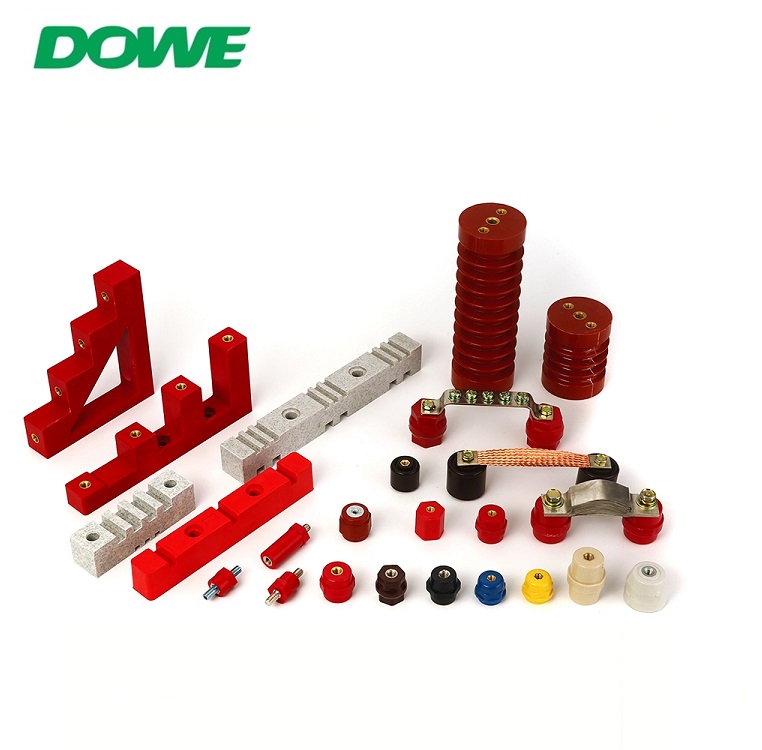
- SB20 (JYZ-20): 20 mm body diameter with three thread options — M5, M6, and M8 — built from high-strength BMC. The three-thread option allows matching to specific torque and load requirements across heights ranging from 16 mm to 90 mm.
- SB30 (JYZ-30): 30 mm body diameter in reinforced BMC/SMC, with M6 and M8 thread options. The M6/M8 configuration enables higher tightening torque up to 26 N·m proof load, supporting higher cantilever loads than the compact SB20 model.
- SB35 (JYZ-35): 35 mm body diameter with a single M10 thread specification in reinforced BMC/SMC. This thread supports torque up to 28–35 N·m working torque and 52 N·m proof torque, addressing applications with elevated tensile and cantilever loads.
- SB40 (JYZ-40): 40 mm body diameter constructed in high-strength SMC using longer glass fibers (25mm–50mm) for superior flexural and tensile performance. With M8 or M10 thread options, this model supports tightening torque from 14–35 N·m.
- SB60 (JYZ-60): 60 mm body diameter, the heavy-duty model in the SB / JYZ line, built in Heavy-Duty SMC with M12 and M16 thread options. The M16 thread configuration supports torque up to 75–95 N·m working torque, intended for the largest mechanical loads in heavy-duty switchgear and utility applications.
This progression — from compact M5/M6 compact models through M16 heavy-duty configurations — gives specifying engineers a structured torque table to select the correct insulator for a given fault-current and mechanical-load profile, rather than relying on generic standoff dimensions.
Material Selection Behind the Torque Table
Torque capacity is only as reliable as the composite body that carries the embedded insert. DOWE's torque table is built on a defined materials ladder:
- BMC (Bulk Molding Compound): Used in compact and standard models for isotropic mechanical properties and precision mold shrinkage control.
- Reinforced BMC/SMC: Applied in mid-range models such as SB30 and SB35, where higher cantilever and tensile loads demand additional composite reinforcement.
- High-Strength SMC with longer glass fibers (25mm–50mm): Used in SB40 and the EL busbar support series for superior flexural and tensile performance against electromagnetic shockwave forces during short-circuit events.
- Heavy-Duty SMC: Reserved for the SB60 model and the HC Heavy Duty busbar support line, which is engineered for short-circuit withstand (Icw) up to 100kA/1s in utility substations and high-current industrial installations.
Insert hardware itself is custom-engineered using cold-pressed brass (H62) or zinc-plated high-tensile steel threaded inserts spanning M4 through M16, allowing the torque table to extend consistently from miniature electronic standoffs to heavy-duty utility-grade supports.
Applying the Torque Table Across Industry Scenarios
The practical value of a documented torque table becomes clear across DOWE's served industries:
- In solar PV inverter DC links and string combiner boxes, correctly torqued SB/JYZ insulators maintain hexagonal anti-rotation base integrity so technicians can hold the base with an open-end wrench while applying full tightening torque, preventing rotational shear stress on the mounting plate.
- In BESS storage cabinets operating at 1,500V DC, proper torque application ensures the insulator maintains its UL 94-V0 self-extinguishing rating and thermal endurance from -40°C to +140°C under continuous thermal loading and heavy vibration during transport and seismic events.
- In utility substations and high-current switchgear using the HC Heavy Duty busbar support line, torque specifications directly support the modular pole configuration's ability to adapt to current capacities up to 6,300A.
- In EV fast charging infrastructure, compact SB14 and SB16 models with M5/M6 threads provide small-format high-voltage DC isolation appropriate for dense power conversion units.
Dimensional Matching and Documentation Support
Because DOWE's SB/JYZ and EL series are engineered for 1:1 drop-in OEM replacement with precision dimensional matching for ABB MNS, Schneider Blokset/Okken, Siemens Sivacon, GE, and Eaton switchgear platforms, the torque table also supports replacement-part specification without panel redesign. The EL-130, EL-170, and GCK series match original mounting hole centers, busbar slot spacing, and creepage dimensions, meaning the torque values documented for threaded inserts remain consistent with original platform requirements.
For design verification, panel builders can reference DOWE's third-party SGS type test reports, which cover dielectric, thermal, and mechanical stress performance, including the tensile pull-out and torsional lock figures that anchor the torque table. This documentation pathway allows engineering teams to complete verification files without conducting independent destructive testing.
Conclusion
A reliable busbar insulator torque table is not a single number but a structured relationship between thread size, body diameter, composite material, and insert engineering. DOWE Electric's SB / JYZ dimensional model series — spanning SB14 through SB60 — along with its EL and HC Heavy Duty busbar support systems, provides this structured reference across low-voltage, medium-voltage, and high-voltage DC applications. For engineers specifying standoff or busbar support insulators in solar, BESS, EV charging, or switchgear projects, this documented torque progression, backed by SGS third-party type testing and compliance with IEC 61439-1/2, IEC 60664-1, and UL 94-V0 standards, offers a dependable basis for fastener selection and long-term mechanical reliability.
http://www.busbarinsulator.com
Yueqing City DUWAI Electric Co.,LTD
About Author