Understanding the Demand Behind Thin-Wall Cup Production
Manufacturers producing disposable cups, yogurt containers, and food packaging face a common set of operational pressures: molding cycles that are too long, inconsistent wall thickness across cavities, surface defects, and energy costs that erode margins. For producers evaluating a thin-wall cup production line, the core question is whether a single integrated system can deliver fast cycles, dimensional consistency, and in-mold decoration without requiring separate post-processing steps.
DKM Machinery and SINO MOULD, technology-driven enterprises headquartered in Zhejiang, China, with business coverage across more than 100 countries and regions, have built their thin-wall packaging offering specifically around this challenge. Rather than supplying machines and molds separately, the two companies deliver combined machine, mold, and automation systems as a single turnkey line, fully commissioned before shipment.
DKM's Thin-Wall IML Production Line: Engineering Behind the Speed
The Thin-Wall IML Production Line is positioned as an integrated solution for high-speed, high-precision thin-wall packaging, combining a DFS injection molding machine, an IML (In-Mold Labeling) mold, an intelligent labeling robot, and precision temperature control. According to the company's technical documentation, this configuration achieves a molding cycle of 2.8 to 3.5 seconds, described as an improvement of over 50% compared with traditional thin-wall lines.
The DFS Series Injection Molding Machine
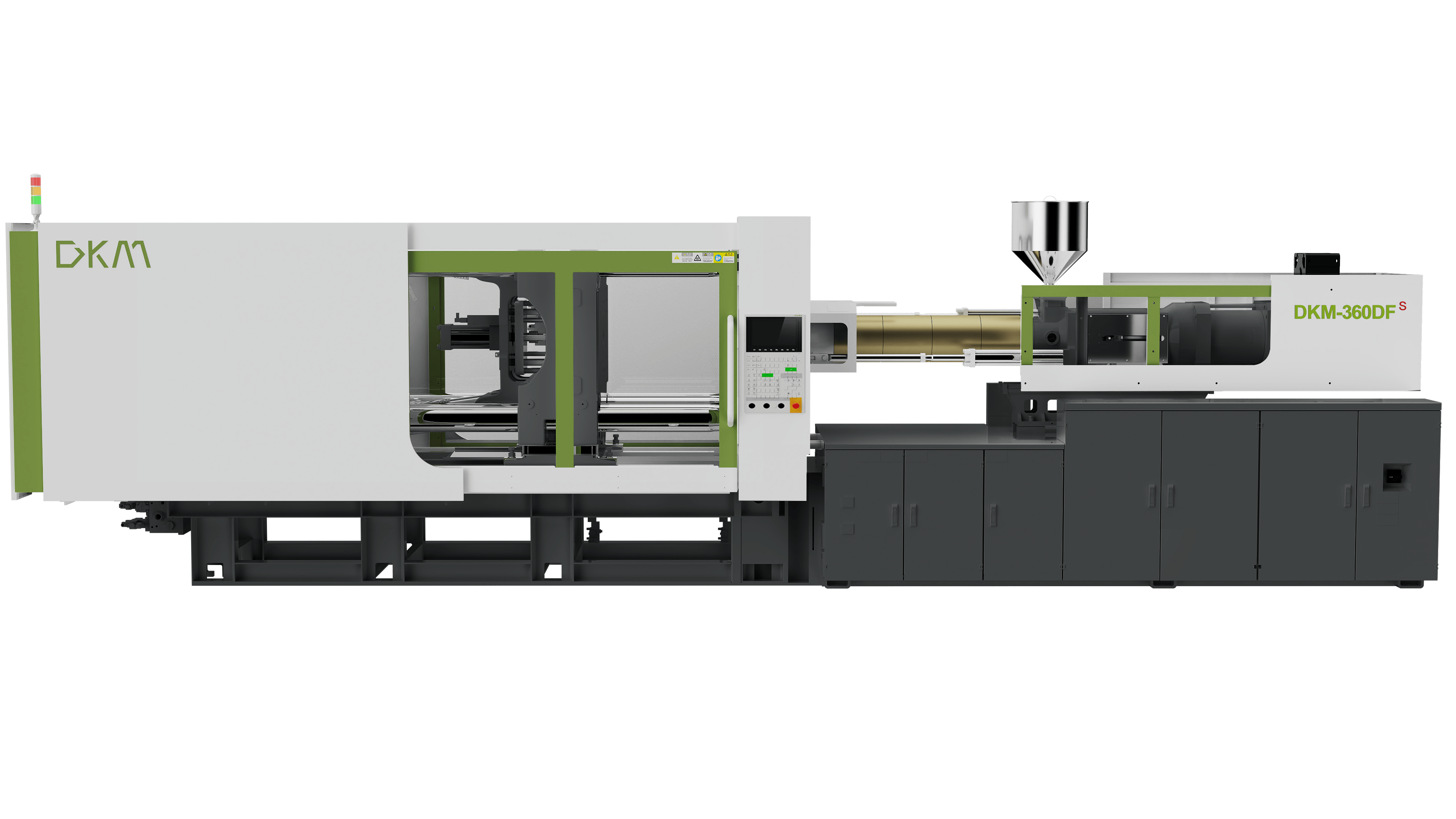
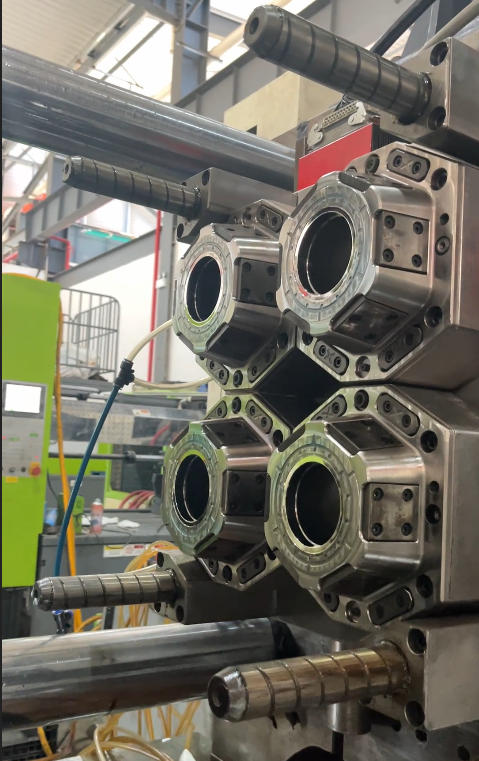
At the core of the line sits the DFS Series Fast Speed Injection Molding Machine, available in clamping forces of 250T, 310T, 360T, and 460T. The machine uses a low-inertia single-cylinder injection system with a hollow piston rod design, reaching an injection speed of 444 mm/s in just 0.13 seconds, with a maximum injection speed of 500 mm/s. This single-cylinder architecture is stated to provide stable and consistent injection pressure, while the elimination of the nitrogen accumulator reduces maintenance requirements and contributes to 25–30% energy savings. The machine also performs mold opening, ejecting, and pre-charging simultaneously through its electric charging feature, which is one of the mechanisms behind the stated 30–50% cycle time reduction.
Shot weight repeatability on the DFS platform reaches ≤2‰, and when paired with Moog servo valves and a KEBA controller, the thin-wall IML line as a whole achieves 1‰ repeatability—an important benchmark for producers running multi-cavity cups where consistency across cavities directly affects scrap rates.
Precision Mold Design for Ultrathin Walls
The Thin-Wall Mold supplied by SINO MOULD supports ultrathin wall sections from 0.28 mm, using DIN1.2344 steel, which is described as the preferred choice over S136 for high-temperature, high-speed, high-pressure molding applications. The mold incorporates synchronized valve gates for multi-cavity consistency and 100% uniform air venting, which supports injection times of approximately 0.3 seconds without eccentricity, gas traps, or short shots. Core and cavity temperature difference is controlled within ±1°C, and mold component tolerance is held to 0.01 mm, both of which are cited as necessary to prevent thermal expansion misalignment in thin-wall parts.
For high-heat zones, the mold design combines beryllium copper—offering 5–8 times the thermal conductivity of H13 steel—with cooling steel for structural strength and wear resistance.
In-Mold Labeling Integration
Labeling is handled through an IML In-Mold Labeling System jointly engineered by DKM, SINO MOULD, and IVI ROBOT. The robot uses a high-precision servo drive with label positioning accuracy of ≤0.01 mm and performs a fully synchronized sequence of picking the label, inserting it, molding, and removing the finished part. This process is reported to produce a yield rate of ≥99%, with no label lifting, shifting, or wrinkling, and the in-mold high-temperature, high-pressure bonding creates a wear-resistant, waterproof, non-peeling label surface—eliminating the need for a separate post-molding labeling step.
Proven Performance: The 8-Cavity Thin-Wall IML Intelligent Cup Line
A concrete demonstration of this technology is the 8-Cavity Thin-Wall IML Intelligent Cup Production Line, which combines the DKM-360DFS high-speed machine with a high-speed IVI-IML robot and an 8-cavity thin-wall cup mold. The line produces cups with a wall thickness of 0.35 mm and cavity height of 120 mm at a cycle time of 5.5 seconds. This configuration was shown as a live production demonstration at CHINAPLAS 2025 at Booth 9P31 in Shenzhen, giving manufacturers a direct, verifiable reference point for expected throughput before committing to a purchase.
Real-World Validation Across Cup Applications
Beyond the exhibition demonstration, the companies report specific production outcomes across different cup and container types. A 500–1000 ml PP/PS tea or drink cup application running on a DKM-360DFS machine with an 8-cavity thin-wall IML mold achieves a 6-second cycle time. A yogurt cup application using the smaller DKM-310DFS machine with a 4-cavity IML mold achieves a cycle time of 5.3 to 5.8 seconds. These figures illustrate how cycle time scales with cavity count and machine tonnage, giving prospective buyers a basis for estimating output on their own cup geometry.
Technical Foundation: 15 Years of Thin-Wall Expertise
These production lines are built on what the company describes as 15 years of thin-wall injection molding research, with more than 600 sets of thin-wall machines and molds produced per year. The underlying technical definition classifies thin-wall molding as wall thickness between 0.2 mm and 0.6 mm for molding areas under 0.1 square meters, with thicker allowances up to 1.5 mm for larger surface areas. For a 0.4 mm wall thickness, filling time is specified at 0.2 to 0.3 seconds, which explains why high injection speed—ranging from 200 to 800 mm/s depending on the series—is treated as a baseline machine requirement rather than an optional feature. An internal barrel heating design is also used to keep external machine temperature below 50°C, reducing thermal energy waste during continuous operation.
This expertise is supported by a broader R&D structure that includes an Italy Technical Office established in 2018 and an Italy Technology Center established in 2023, alongside sustained R&D investment that has accounted for 8–10% of sales revenue over the past ten years.
Why Manufacturers Choose DKM and SINO MOULD
For companies comparing options, the value proposition centers on reduced molding cycle time of 30–50%, shortened time-to-market, lower unit costs, and improved part quality and repeatability for packaging producers. Because the machine (DKM), mold (SINO MOULD), and labeling robot (IVI ROBOT) are matched as original equipment and jointly trial-run before delivery, buyers avoid the integration risk that typically comes from sourcing these three components separately. Thin-wall and IML molds carry a qualified delivery timeline within one month, and the group maintains third-party certifications including CE marking and ISO 9001/TS16949 quality management, offering an additional layer of assurance for international buyers.
Conclusion
The thin-wall cup production line segment illustrates how DKM Machinery and SINO MOULD apply joint equipment-mold-automation engineering to a specific, high-volume packaging challenge. With documented cycle times from 5.5 to 6 seconds on 8-cavity cup configurations, 1‰ repeatability, and ≥99% yield rates validated through live demonstrations and direct customer applications, the companies offer manufacturers a reference-tested path to higher-speed, higher-consistency thin-wall cup production.
https://dkm.com/dfs-low-inertia-high-speed-machine/
DKM Machinery
About Author