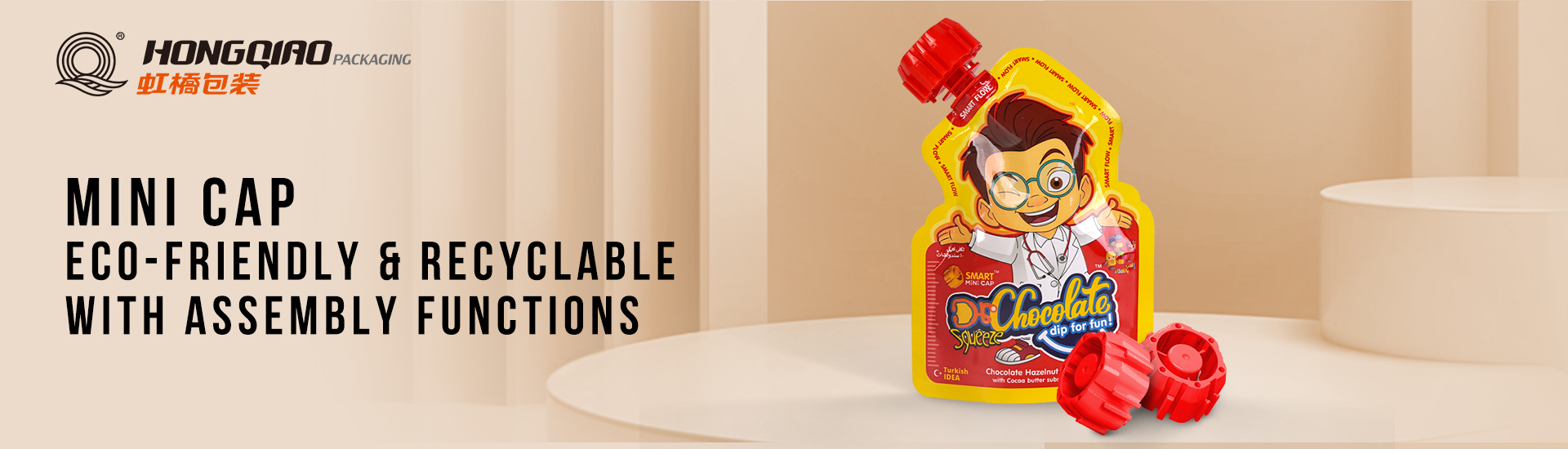
Why Customization Defines the MINI CAP Assembly Advantage
Mini Cap (Guangdong) Creative Culture Co., Ltd. is a subsidiary of the creative pouch cap brand under the Shantou Hongqiao Packaging Industrial Co., Ltd.
For brands navigating a market defined by product homogenization and mounting environmental pressure around plastic reduction, MINI CAP offers a distinct answer to a question many packaging buyers are now asking: how can a functional component become a source of differentiation, safety, and consumer engagement all at once? The response lies in its patented, regular hexagonal interlocking cap design and the customization framework built around it.
From Component Supplier to End-to-End Partner
MINI CAP's strategic positioning centers on a shift away from being a simple parts supplier. Instead, the brand operates as an end-to-end business solution provider, integrating packaging innovation, manufacturing, and diversified business models. This positioning directly addresses pain points identified across three stakeholder groups:
- Brands facing high levels of product homogenization, weak shelf appeal, and pressure to reduce plastic and improve packaging reuse.
- Consumers who discard one-time packaging after a single use, while small caps pose accidental swallowing and choking hazards for young children.
- Environmental advocates concerned about underdeveloped recycling systems for flexible packaging, where small caps are easily lost during disposal and hinder reclamation.
By transforming functional closures into reusable educational assets, MINI CAP reframes a disposable component as a long-term brand touchpoint.
The Customization Advantage: Modular Structure Meets Brand Identity
At the technical core of MINI CAP's assembly advantage is its modular interlocking structure — a patented regular hexagonal architecture featuring 8 buildable surfaces (6 side facets, 1 top face, 1 bottom face) that supports 10 distinct assembly methods. This structural versatility is what enables deep customization opportunities for brand partners, since the same base architecture can be adapted across customized aesthetics, IP character integrations, and systematic brand marketing strategies.
Key differentiated advantages supporting this customization include:
- Reusability & Eco-Friendliness: MINI CAP converts one-time packaging caps into reusable educational building blocks, eliminating waste at the source rather than managing it after the fact.
- Brand Value Uplift: The closure system drives consumer engagement and repeat purchases through a "food + toy tie-in sales" model, giving brands a mechanism for ongoing interaction rather than a single transaction.
- Child Safety: An anti-choking size design prevents accidental swallowing hazards, directly addressing a core consumer pain point.
Technical Foundations Behind the Customization
Customization is only viable at scale if the underlying engineering holds up. MINI CAP's technical metrics reflect this:
- Structural Durability: The cap withstands over 100 assembly and disassembly cycles without structural degradation or locking mechanism failure, meaning customized assembly designs can be played with repeatedly without losing integrity.
- Opening Torque: Calibrated between 3 and 6 N·cm, balancing leak prevention with child-friendly opening safety.
- Spout Compatibility: Compatible with standard 8.5mm and 10mm spout diameters, ensuring customized caps fit mainstream spouted stand-up pouches without altering filling or drinking function.
The technical methods behind this include modular interlocking mechanics featuring recessed grooves, protruding tabs, circular studs, and sockets, combined with snap-on interlocking and lateral elastic deformation zones that allow easy, tool-free twist-off and non-destructive disassembly for cleaning and reuse.
Materials and Safety as Part of the Customization Equation
Customization at MINI CAP is not limited to shape and branding — it extends to material safety. The caps are made of food-grade, BPA-free, heat- and cold-resistant PE / PP in a mono-material structure, which simplifies recycling while meeting food-contact safety requirements. Combined with interference-fit internal annular threads that guarantee leak prevention, the design allows customized versions to maintain consistent safety performance across different brand applications.
Educational Customization: Beyond the Physical Cap
A distinguishing feature of MINI CAP's customization approach is that it extends beyond the object itself into accompanying educational content. Each closure can be packaged with assembly guides, online courses, and mission cards to facilitate interactive learning. This is reinforced by the "Second Classroom" initiative in schools, which integrates mini-caps into classrooms through cap painting, assembly blocks, and eco-friendly handicrafts — demonstrating how the same core product can be customized for educational institutions as a distinct customer type, alongside food and beverage brands and IP licensors.
Market Validation: Customization in Practice
The clearest evidence of MINI CAP's customization advantage comes from its benchmark collaboration with Bestore, Crayon Shin-chan, and Gudu Huatian. This partnership combined retail food brands (Bestore, Gudu Huatian) with a character IP (Crayon Shin-chan) to implement a "food + toy tie-in sales" model. The implementation results show that this approach successfully established a dynamic consumer ecosystem and traffic-driven marketing scenarios, illustrating how customized IP integration can transform a standard closure into an active brand co-creation tool and a driver of deeper consumer emotional connection.
This case also reflects MINI CAP's broader industry adaptation, spanning:
- Kids' Dairy & Snacks: Safe, engaging closures for yogurts, purées, and milks.
- Trendy Foods & Beverages: High-appeal closures for coffee, cocktails, jams, and pet foods.
Delivery Model: Customization Built Into the Service
MINI CAP's customization capability is matched by a Full-Value-Chain Solution that combines Customized Design, IP Customization, Manufacturing, and Brand Marketing Partnership. The service scope covers product ideation, IP character design, packaging execution, omnichannel marketing strategy, experiential showroom planning, and educational curriculum collaboration — meaning brands engaging MINI CAP for assembly cap customization receive support across the entire lifecycle, from initial concept to market rollout.
Conclusion
The customization advantages of MINI CAP's Assembly Cap stem from the convergence of a technically robust modular hexagonal structure, rigorous safety and durability standards, and a service model that extends customization into IP integration, education, and omnichannel marketing. For food and beverage brands, IP licensors, and educational institutions alike, this combination positions MINI CAP as a practical route to turning a single-use closure into a reusable, brand-aligned, and consumer-engaging asset.
https://www.hqpack.com
Mini Cap (Guangdong) Creative Culture Co., Ltd.
About Author