Choosing the right all-terrain vehicle (ATV) involves more than comparing engine sizes, top speeds, or exterior designs. The best ATV should match your riding environment, intended application, experience level, comfort requirements, and budget. Whether you plan to explore off-road trails, work on a farm, transport equipment, or enjoy outdoor recreational activities, understanding the differences between ATV models will help you make a more informed decision.
With so many ATV options available, buyers need to evaluate several factors before selecting a suitable model. Engine displacement, drivetrain configuration, suspension performance, cargo capacity, tire design, and maintenance requirements can all influence the overall riding experience. A vehicle designed for utility work may not deliver the same performance as a sport ATV built for recreational riding, while a compact model may be more practical than a full-size vehicle for certain users.
This guide explains how to choose the right ATV for your riding needs, covering the essential specifications and practical considerations that matter most when comparing different all-terrain vehicles.
1. Identify Your Primary ATV Riding Purpose
The first step in choosing the right ATV is determining how you intend to use it. Different riding activities require different combinations of power, handling, durability, and functionality. Identifying your primary application will help you narrow down the available ATV models and avoid paying for features you rarely need.
Recreational Trail Riding
If you primarily ride on forest trails, open fields, or designated off-road routes, look for an ATV that offers balanced handling, responsive acceleration, and comfortable suspension.
A recreational ATV should provide enough power to handle moderate inclines and uneven surfaces without becoming difficult to control. Suspension travel, ground clearance, and tire traction are particularly important when riding over rocks, roots, and loose soil.
For riders who enjoy exploring different terrains, a versatile ATV with a reliable engine and predictable steering can provide a more enjoyable experience than a vehicle designed exclusively for high-speed performance.
Farm and Agricultural Work
For agricultural applications, an ATV should prioritize practicality, durability, and load-carrying capability. Farmers and landowners often use ATVs to inspect property, transport tools, carry feed, move supplies, and travel between fields.
When selecting an ATV for farm work, consider features such as:
-
Front and rear cargo racks for transporting equipment.
-
A suitable towing capacity for compatible trailers and implements.
-
Four-wheel drive for improved traction on muddy or uneven ground.
-
Durable tires that perform well on grass, gravel, and dirt.
-
A comfortable riding position for extended working hours.
An ATV designed for utility applications can help reduce the time and physical effort required for routine outdoor tasks. However, buyers should always check the manufacturer's specified payload and towing limits before carrying heavy loads.
Hunting, Camping, and Outdoor Exploration
Outdoor enthusiasts often need an ATV that combines maneuverability, traction, storage capacity, and dependable performance. Narrow trails and wooded environments may favor a compact model, while larger properties and rugged terrain may require additional ground clearance and stronger traction.
For camping trips, storage accessories can make a significant difference. Front and rear racks, compatible cargo boxes, and secure mounting points help riders transport essential supplies without interfering with vehicle handling.
If you frequently travel through remote areas, reliability and ease of maintenance should also be priorities. A practical ATV should support your planned activities without adding unnecessary complexity.
Sport and Performance Riding
Sport ATVs are designed for riders who prioritize acceleration, responsive handling, and an engaging riding experience. These vehicles commonly feature performance-oriented suspension systems, lightweight construction, and ergonomics that support active rider movement.
When comparing sport ATV models, pay attention to throttle response, braking performance, suspension adjustability, and overall weight. Engine power is important, but a powerful ATV is not automatically the best choice for every rider.
Beginners should focus on manageable performance and predictable handling rather than selecting a high-powered vehicle solely because of its speed specifications.
2. Choose the Appropriate ATV Engine Size
Engine displacement is one of the most frequently compared specifications when purchasing an ATV. It is usually measured in cubic centimeters (cc) and provides a general indication of engine size.
However, displacement alone does not determine how an ATV performs. Engine design, vehicle weight, transmission characteristics, gearing, and power delivery also influence acceleration and low-speed control.
The appropriate ATV engine size depends on your experience, terrain, load requirements, and intended application.
Smaller-Displacement ATVs
Smaller-displacement models are often suitable for beginners, lighter recreational use, and applications where maneuverability matters more than maximum power.
Potential advantages include manageable power delivery, relatively compact dimensions, and convenient handling in confined spaces. These characteristics can make a smaller ATV appealing to riders who do not need to carry substantial loads or navigate particularly demanding terrain.
Nevertheless, buyers should check the vehicle's rated capacity and intended rider category. A compact ATV is not automatically suitable for every adult rider or every working environment.
Mid-Range ATV Engines
Mid-range ATVs often provide a useful balance between power, handling, and versatility. They may suit recreational trail riding, property maintenance, and selected utility applications.
For buyers who want one ATV to perform several different tasks, a mid-range model can be a practical option if its specifications match the expected workload.
When comparing engines in this category, examine torque characteristics, cooling systems, transmission type, and manufacturer performance data instead of relying on displacement alone.
Large-Displacement ATVs
Large-displacement ATVs are generally intended for applications that demand greater performance or more substantial working capability. Depending on the model, they may offer stronger acceleration, improved power reserves, or greater suitability for demanding terrain.
However, larger engines can also increase vehicle weight, fuel consumption, and purchase costs. More power may require greater rider skill, particularly on steep slopes, loose surfaces, or narrow trails.
The best ATV engine size is the one that provides sufficient performance for your actual needs while remaining manageable and appropriate for your experience level.
3. Understand Two-Wheel Drive and Four-Wheel Drive
The drivetrain has a direct impact on how an ATV handles different surfaces. Before choosing a model, consider the terrain you encounter most frequently and whether additional traction is necessary.
Two-Wheel-Drive ATV
A two-wheel-drive ATV is often suitable for relatively firm, predictable surfaces, including dry trails, maintained paths, and open fields.
Depending on its design, a 2WD model may offer a simpler drivetrain and lower purchase cost than a comparable four-wheel-drive vehicle. It can be an appropriate choice for recreational riders who rarely encounter deep mud, loose sand, or steep and slippery inclines.
However, traction can become a limitation when surface conditions deteriorate. Buyers should assess their typical riding environment rather than choosing two-wheel drive solely to reduce the initial cost.
Four-Wheel-Drive ATV
A 4WD ATV can provide improved traction when traveling over challenging surfaces. It is particularly useful for muddy farmland, loose gravel, uneven woodland trails, and other environments where wheel grip is inconsistent.
Some models also offer selectable drive modes, allowing riders to adapt the drivetrain to changing conditions. Depending on the vehicle, additional features may include differential locking or specialized traction-control functions.
When comparing a four-wheel-drive ATV, check whether the system is selectable or continuously engaged, how it operates, and whether the model includes a differential-lock function.
Remember that four-wheel drive does not eliminate the risk of slipping or tipping. Safe speed, suitable tires, and proper riding technique remain essential.
4. Consider the Terrain and Ground Clearance
Your riding environment should influence almost every aspect of ATV selection, including tire design, suspension, drivetrain, and vehicle dimensions.
An ATV that performs well on dry farmland may be less suitable for rocky mountain trails or deep mud. Matching the vehicle to the terrain can improve control, reduce unnecessary wear, and make riding more comfortable.
Muddy and Wet Terrain
For muddy environments, prioritize effective tread patterns, adequate ground clearance, and suitable drivetrain capabilities.
Mud tires often use more aggressive tread designs to help remove accumulated soil and maintain traction. However, the appropriate tire depends on the vehicle, surface conditions, and intended use.
If you regularly work in wet agricultural areas, consider how easily the ATV can be cleaned and whether important components are adequately protected against moisture and debris.
Rocky and Uneven Trails
Rocky terrain requires a combination of ground clearance, suspension performance, and tire durability.
A higher ground clearance can help reduce contact between the underside of the vehicle and obstacles. Meanwhile, a capable suspension system can improve wheel movement over uneven ground and help maintain tire contact with the surface.
Look for adequate underbody protection where appropriate, but do not assume that maximum ground clearance alone guarantees better off-road performance. Stability, center of gravity, and overall vehicle geometry also matter.
Sand and Loose Soil
Sand and loose soil can create additional resistance and reduce traction. An ATV intended for these conditions should have a suitable power-to-weight balance and tires designed for the expected surface.
Riders should also consider tire pressure recommendations and manufacturer guidance for specific terrain. Incorrect tire pressure can affect handling, traction, and tire durability.
5. Evaluate Suspension and Riding Comfort
Suspension quality is an important consideration when choosing an ATV for extended rides or uneven working environments. A suitable suspension system helps absorb impacts, supports wheel movement, and contributes to vehicle stability.
The best suspension setup depends on the ATV's intended use, weight, and terrain.
For recreational trail riding, look for a suspension system that provides predictable handling and sufficient travel for the obstacles you expect to encounter. Sport-oriented riders may prefer adjustable suspension settings that allow them to adapt the vehicle to different conditions.
For agricultural and utility applications, suspension performance should balance comfort with the demands of carrying equipment and operating over uneven ground.
Seat design, handlebar position, footrest placement, and control accessibility also affect comfort. If possible, assess the ATV's riding position before purchasing it. Your knees, arms, and back should remain in a natural position when operating the controls.
6. Check ATV Payload Capacity and Towing Capability
For buyers who need an ATV for work, payload capacity and towing capability can be just as important as engine performance.
Payload capacity generally refers to the total weight the vehicle is designed to carry, including the rider, passengers where permitted, accessories, and cargo. The precise definition and calculation should be confirmed in the manufacturer's documentation.
Towing capacity indicates the load the ATV is rated to pull under specified conditions. It should not be confused with payload capacity or engine power.
Before selecting a utility ATV, answer the following questions:
-
How much equipment or cargo will you carry regularly?
-
Will you need to tow a compatible trailer?
-
Will you operate on level ground, slopes, or soft surfaces?
-
Do the cargo racks provide sufficient space for your equipment?
-
Will additional accessories affect the vehicle's rated load limits?
A model with practical storage and suitable towing specifications may be more useful for farm work than a faster ATV with limited carrying capability.
7. Compare ATV Transmission Types
Transmission design affects how easily a rider can control the vehicle and adapt to different riding conditions.
Many modern recreational and utility ATVs use continuously variable transmissions (CVTs), which automatically adjust the transmission ratio according to operating conditions. This can simplify operation, particularly for riders who prefer not to change gears manually.
Other models may feature manual or semi-automatic transmission systems, depending on their intended application.
When comparing ATV transmission options, consider your riding experience, typical terrain, and maintenance preferences.
An automatic or CVT-equipped ATV may be convenient for general recreational riding and utility work. A manual transmission may appeal to riders who prefer greater direct control over gear selection.
Also check how the transmission behaves at low speeds, whether the vehicle includes suitable engine braking, and what maintenance procedures the manufacturer recommends.
8. Pay Attention to ATV Safety Features
Safety should be a fundamental part of the ATV purchasing process. A suitable vehicle should provide reliable braking, predictable handling, accessible controls, and protective features appropriate to its design.
When evaluating ATV safety specifications, review the following components.
Braking system: Check the brake configuration, braking response, and manufacturer's maintenance recommendations. Reliable brakes are especially important when riding on slopes or carrying loads.
Lighting and visibility: Headlights, taillights, and other required lighting equipment help improve visibility in suitable riding conditions. Verify that the vehicle meets the requirements of your intended riding location.
Emergency controls: Understand the location and operation of the engine stop switch and other essential controls before riding.
Stability and ergonomics: Choose a vehicle that matches your size, strength, and experience. A machine that feels difficult to steer or control may be inappropriate even if its specifications appear attractive.
Protective equipment compatibility: Select a properly fitted, certified helmet and other suitable protective equipment. Follow the manufacturer's guidance regarding passenger use, as many ATVs are designed for a single rider.
Buyers should also verify local laws, minimum rider-age requirements, registration rules, and restrictions on where ATVs may be operated.
9. Consider Build Quality, Materials, and Durability
An ATV may encounter dust, vibration, water, mud, impacts, and changing temperatures throughout its service life. Build quality therefore plays a significant role in long-term value.
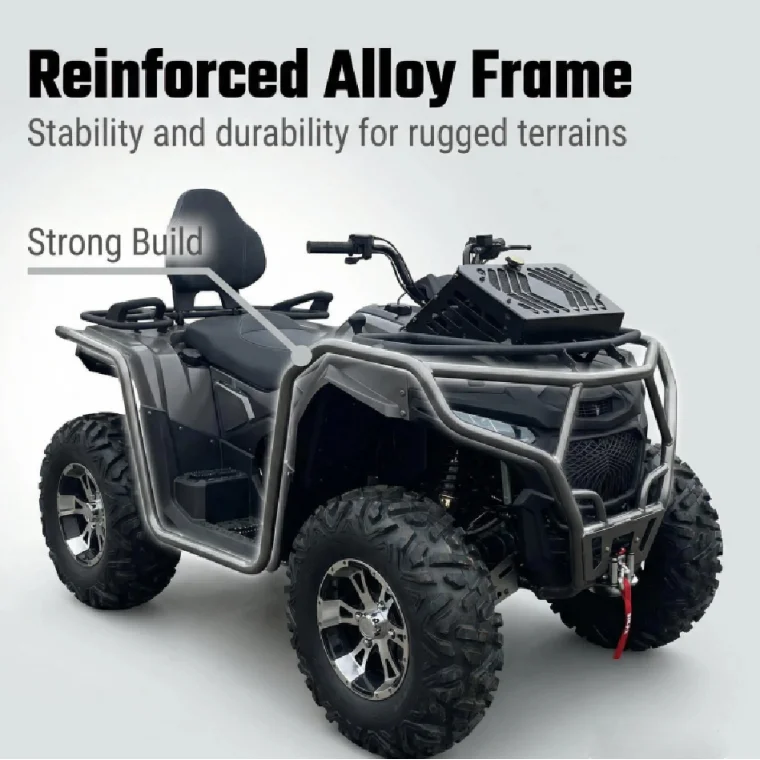
When comparing ATV manufacturers and models, examine the frame construction, suspension components, wheel design, bodywork, and protection for exposed mechanical parts.
For utility applications, durability may be more important than decorative styling. Reinforced components, practical cargo racks, and well-protected systems can support regular operation in demanding environments.
Cooling performance is another consideration. Air-cooled and liquid-cooled engines have different design characteristics, and their suitability depends on the vehicle and operating conditions. Review the manufacturer's specifications to understand the cooling system's maintenance requirements and intended operating range.
You should also investigate parts availability, service documentation, warranty coverage, and the accessibility of routine maintenance points.
10. Calculate the Total Cost of ATV Ownership
The purchase price is only one part of the overall cost of owning an ATV. Buyers should also account for the recurring expenses associated with operating, maintaining, and storing the vehicle.
Important cost factors include:
-
Fuel consumption and the availability of suitable fuel.
-
Routine engine oil and filter changes.
-
Air filter cleaning or replacement.
-
Tire replacement and puncture repairs.
-
Brake servicing and drivetrain maintenance.
-
Protective equipment and compatible accessories.
-
Insurance, registration, and transportation where applicable.
-
Storage and seasonal maintenance requirements.
Conclusion
Choosing the right ATV for your riding needs requires a careful assessment of your intended application, riding environment, engine requirements, drivetrain, suspension, load capacity, safety features, and long-term ownership costs. The most suitable model is not necessarily the largest or most powerful ATV, but the one that delivers the right combination of performance, comfort, durability, and practicality for your specific requirements.
Before making a purchase, compare technical specifications, review maintenance recommendations, verify safety requirements, and confirm that the vehicle's capabilities match your expected workload and terrain. If you plan to use the ATV for several purposes, prioritize versatility without overlooking the requirements of your most demanding regular task.
For buyers seeking dependable products and professional supplier support, Jilang Motorcycle, a professional motorcycle supplier, offers a starting point for exploring suitable vehicle options and evaluating products for different riding applications. By working with an experienced supplier and carefully matching ATV specifications to your needs, you can make a more informed purchasing decision and select an all-terrain vehicle that supports your riding goals over the long term.
www.jilangmotor.com
jilangmotor
About Author