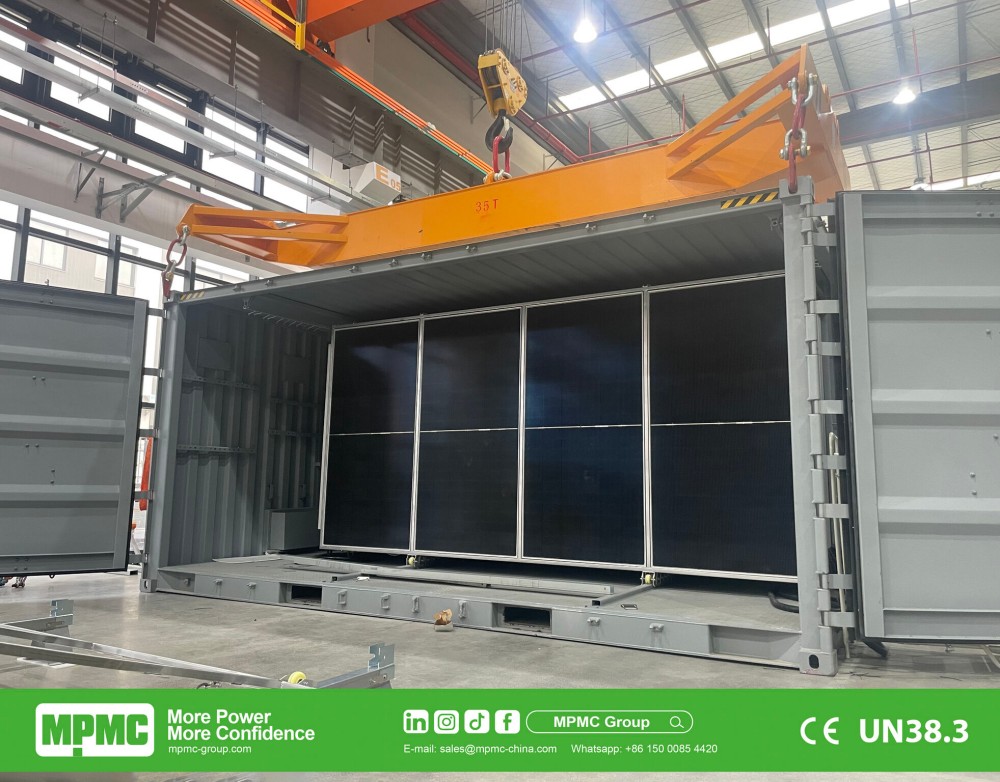
A containerised deployable solar plant answers a specific problem: a site needs generation now, will not need it in this position permanently, and has no appetite for a civil works programme. What it does not answer is what happens after dark. From a procurement perspective the assessment covers deployed area, transport and what the array is paired with, rather than the peak rating alone. MPMC POWERTECH CORP., established in 2008 and headquartered in Shanghai Pudong, publishes an SPK series of mobile solar plants from 7.65 kWp to 231.84 kWp.
MPMC SPK-100 mobile solar array
Deployed Area, Not Rating, Is the Constraint
Solar output depends on area, and area is what a container has least of until the array is opened out. MPMC lists the SPK series from the SPK-8A at 7.65 kWp and 1,100 kg with automatic expansion, through 10.56 kWp and 21.24 kWp, to 115.92 kWp shipped in a 20HQ container and 231.84 kWp in a 40HQP at 30,000 kg.
The figures worth extracting are weight and deployed footprint rather than peak rating. A 30,000 kg unit requires lifting capacity, a transport route and ground bearing that a remote site may not have, and the deployed array needs clear space with the right orientation. Confirming both before capacity is fixed avoids selecting a system the site cannot receive.
Reading the Range Against Site Access
|
Model |
Rated capacity |
Transport |
Where it fits |
|
SPK-8A |
7.65 kWp |
1,100 kg; automatic expansion |
Small loads; single-vehicle delivery and rapid setup |
|
SPK mid-range |
10.56–21.24 kWp |
Trailer or light transport |
Camps, monitoring stations, small workshops |
|
SPK-100 class |
115.92 kWp |
20HQ container |
Substantial site loads with space to deploy |
|
SPK-200 class |
231.84 kWp |
40HQP container; 30,000 kg |
Large off-grid loads; requires crane and ground bearing |
Availability varies by rating and region, so the deployed dimensions, weight and lifting arrangement should be confirmed for the specific model in the technical offer rather than inferred from the class.
Solar Alone Does Not Run a Site
An array generates while the sun is up and nothing afterwards, so a deployable solar plant is almost always one element of an arrangement rather than the whole answer. What it is paired with determines whether the site actually works.
MPMC publishes two routes. For smaller loads the GSB series integrates solar, generator and battery on one mobile chassis from 10 to 120 kVA maximum output with 20.4 to 112.5 kWh of battery capacity. For larger arrangements the SPK array pairs with separate storage — the HBD-R series from 30 kW to 610 kW continuous, or the stationary HBD-A series from 125 kW and 261 kWh — and with containerised generation.
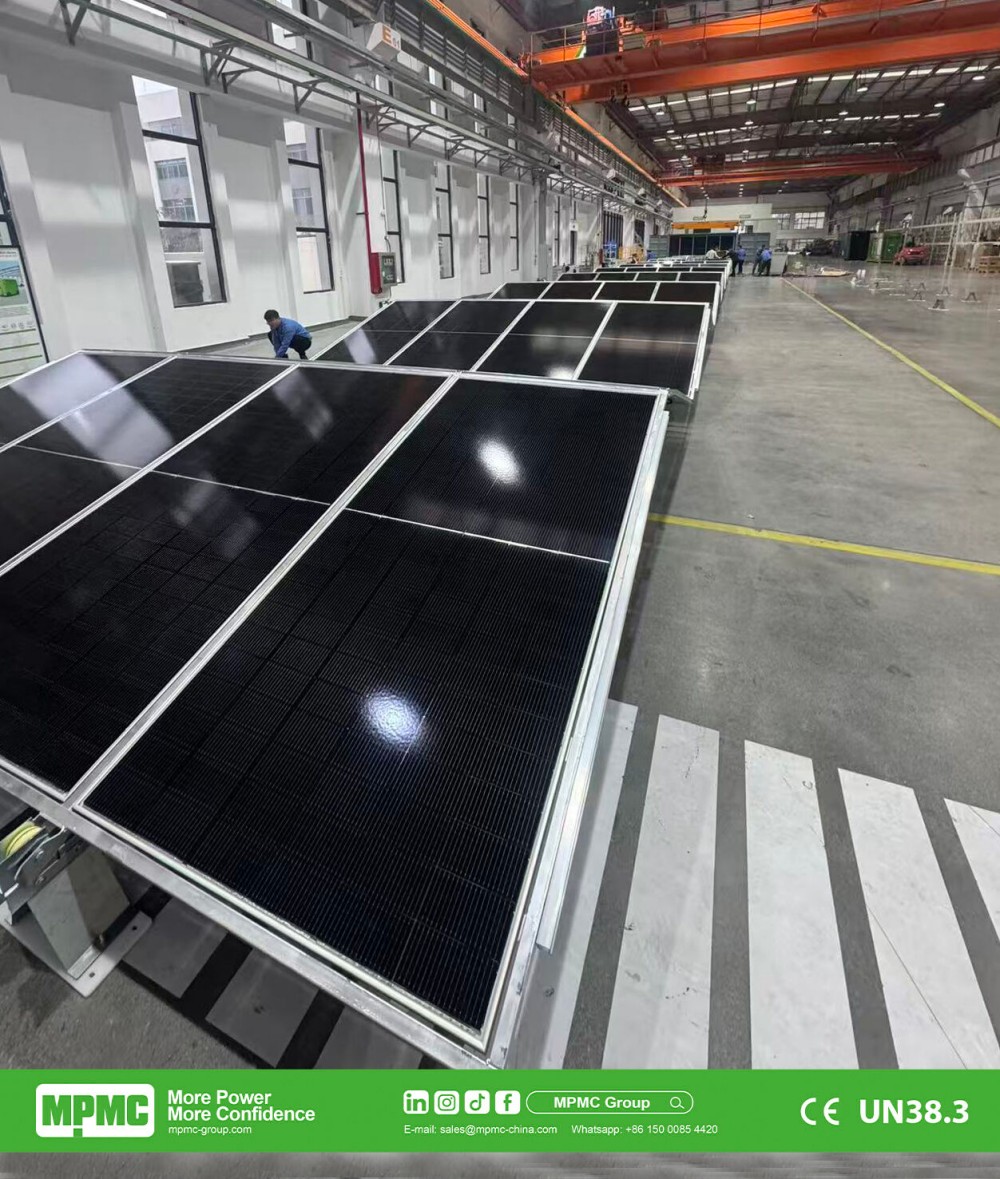
MPMC SPK-100 mobile solar array
Rapid Deployment in Practice
The deployment claim should be tested against a timeline rather than accepted as a category. The SPK-8A is listed with automatic expansion at 1,100 kg, which is a genuinely rapid arrangement; the container-shipped models require unloading, positioning and opening out, which is a different exercise.
What integration removes in every case is the civil works programme. What remains is site preparation, the electrical connection to whatever the array is feeding, and any local approval, and a realistic plan allows for all three.
Output Falls Away From the Nameplate
Soiling reduces photovoltaic output progressively rather than suddenly, which on a dusty remote site turns cleaning into an operational task rather than a maintenance one. An array that performs to expectation in week one may not by week six unless the regime keeps pace.
High ambient temperature reduces panel efficiency separately, and storage paired with the array carries its own limits: MPMC lists −20°C to +55°C with derating above 45°C on the HBD-A series and −20°C to +50°C on the HBD-R series, with a maximum altitude of 3,000 m. Specifying margin above the strict requirement is what absorbs both effects between service visits.
Where the Combination Is Documented
MPMC lists a Kenyan microgrid programme of 6 MW across four sites, each with more than 1 MW of solar generation, at least 1 MWh of DC-coupled battery storage rated at 80% depth of discharge and 6,000 cycles with dual-unit redundancy, and diesel backup of two 500 kW plus two 250 kW units per site.
An Australian mining programme is listed at 14.7 MW using 245 GSB hybrid power stations. These describe the class of project delivered; another site's generation split and engine runtime follow its own resource and demand profile.
Control on an Unattended Site
MPMC lists a self-developed SCADA and EMS supporting PQ, VF and VSG modes, black start, grid-forming, intelligent generation dispatch and reactive power regulation, with real-time monitoring, alarm and fault management, up to ten years of data retention and StarLink satellite communication as a backup link.
The dispatch decisions worth settling before order are which source serves which load, the state of charge at which an engine starts, and whether solar is prioritised for direct supply or for charging. Those settings determine how much of the available saving is realised.
Deployment Verification Points
• Confirm the deployed footprint, weight and lifting arrangement for the specific model.
• Verify the transport route, ground bearing and available lifting capacity at the site.
• Establish the daily energy requirement after dark, not only the daytime load.
• Decide whether an integrated chassis or separate components suits the staff available.
• Test the deployment claim against a realistic timeline for your own crews.
• Allow output margin for soiling between cleaning visits and for high ambient temperature.
• Settle the dispatch strategy, including engine start thresholds and solar prioritisation.
• Confirm the monitoring path, its satellite backup and who responds to alarms.
https://www.mpmc-group.com/
MPMC Powertech Corp.
About Author