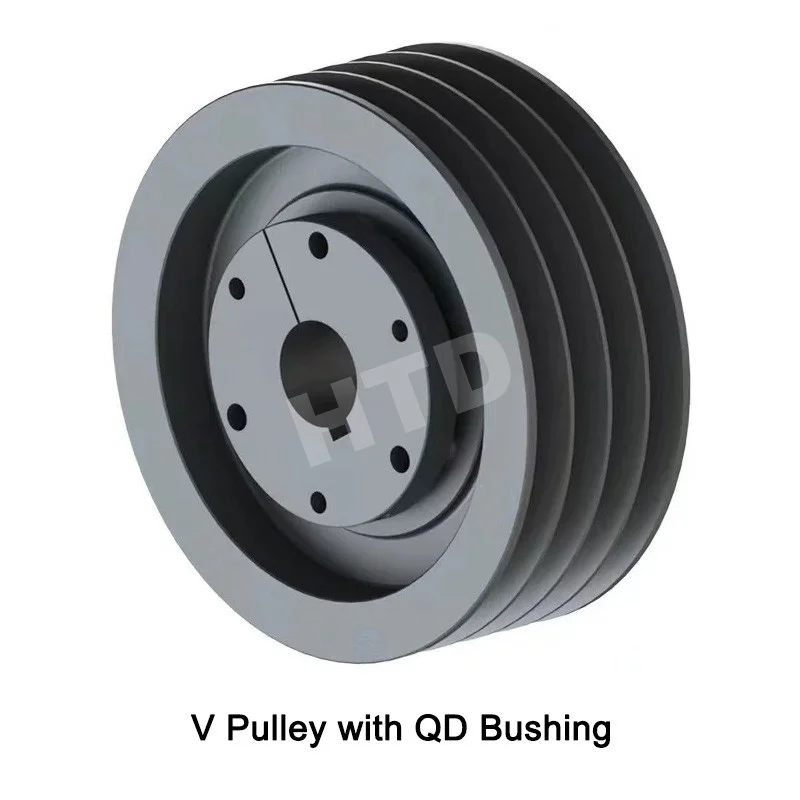
In modern industrial equipment, power transmission components are becoming smaller, faster, and more precise. From automated packaging machines and textile equipment to food processing lines and compact conveyors, every rotating component directly influences the efficiency and reliability of the entire system. Among these transmission components, the small v belt pulley plays a surprisingly important role.
Although compact in size, a small V belt pulley determines belt stability, transmission accuracy, load distribution, and service life. A poorly designed pulley may lead to belt slipping, excessive vibration, uneven wear, or unexpected downtime. Conversely, a high-precision pulley can significantly improve transmission efficiency and reduce maintenance costs over the equipment's lifecycle.
As industrial automation continues to advance, choosing the right small V belt pulley is no longer a matter of selecting a standard component. It has become an engineering decision that affects the performance and competitiveness of the entire machine.
Why Small V Belt Pulleys Are Still Widely Used
Despite the rise of direct-drive motors and servo technologies, V-belt transmission remains one of the most reliable and cost-effective power transmission methods.
Small V belt pulleys are especially common in compact machinery where installation space is limited but stable torque transmission is required. Their wedge-shaped grooves increase friction between the belt and pulley, enabling efficient power transfer without excessive belt tension.
Compared with flat belts, V belts offer better anti-slip performance and can transmit larger loads within smaller dimensions. Compared with gear drives, V belt systems generate less noise, absorb vibration effectively, and require lower manufacturing costs.
These advantages make small V belt pulleys widely used in applications such as:
-
Packaging and labeling machines
-
Agricultural equipment
-
Food processing systems
-
HVAC fans and blowers
-
Textile machinery
-
Medical devices
-
Small industrial conveyors
-
Printing equipment
In these applications, the pulley may appear to be a simple mechanical part, but its design directly affects the performance of the entire drive system.
Precision Machining Determines Transmission Stability
The most critical requirement for a small V belt pulley is dimensional accuracy.
The groove angle, groove depth, pitch diameter, and concentricity must all be manufactured within strict tolerances. Even minor deviations can affect belt alignment and contact pressure, resulting in uneven load distribution and accelerated wear.
Take concentricity as an example.
If the pulley rotates eccentrically by only a few hundredths of a millimeter, vibration levels can increase significantly at high speeds. This vibration may shorten bearing life, generate additional noise, and reduce the accuracy of connected equipment.
Surface finish is equally important.
A rough groove surface increases friction and accelerates belt wear, while an overly smooth surface may reduce grip and cause slipping. Manufacturers therefore carefully control machining parameters to achieve the optimal balance between friction and durability.
For high-speed applications operating above 3,000 rpm, dynamic balancing is often required. Proper balancing reduces centrifugal forces and improves system stability, especially in compact equipment where vibration tolerance is limited.
The precision of these manufacturing details often determines whether a pulley can operate reliably for thousands of hours or become a frequent maintenance issue.
Material Selection Influences Performance and Lifespan
The operating environment largely determines the most suitable pulley material.
Cast iron remains one of the most widely used materials because of its excellent wear resistance, vibration damping capability, and cost efficiency. It is particularly suitable for industrial machinery operating under moderate to heavy loads.
Steel pulleys offer higher strength and impact resistance. They are commonly used in applications involving shock loads or demanding operating conditions.
Aluminum alloy pulleys are gaining popularity in lightweight equipment. Compared with cast iron, aluminum pulleys can reduce rotational inertia significantly, allowing faster acceleration and deceleration. This characteristic is especially valuable in automation equipment where rapid response is required.
Engineering plastics and composite materials are also used in certain applications. Their corrosion resistance and low weight make them suitable for environments involving moisture, chemicals, or food contact.
Material selection should not be based solely on cost.
Factors such as rotational speed, operating temperature, torque requirements, corrosion resistance, and expected service life all influence the optimal material choice. A properly selected pulley material can extend belt life and reduce maintenance frequency, creating long-term economic benefits.
Compact Equipment Requires Customized Pulley Solutions
Industrial equipment is becoming increasingly compact.
Manufacturers are seeking higher productivity while reducing machine footprints, creating new challenges for transmission component design. Standard pulley sizes may not always fit within restricted installation spaces or meet specific speed ratio requirements.
As a result, customized small V belt pulleys are becoming increasingly common.
Customization may involve adjustments to groove profiles, bore dimensions, keyways, flange designs, or surface treatments. Some applications require lightweight designs with reduced rotational inertia, while others prioritize high torque capacity or corrosion resistance.
For example, food processing equipment often requires stainless steel pulleys or special surface coatings to comply with hygiene regulations. Automated production lines may require high-precision pulleys with extremely tight dimensional tolerances to ensure positioning accuracy.
The ability to provide customized solutions has therefore become an important competitive advantage for transmission component manufacturers.
Surface Treatment Can Significantly Improve Durability
In many operating environments, the pulley surface is continuously exposed to friction, dust, moisture, or chemical substances.
Without proper protection, wear and corrosion can gradually reduce transmission efficiency and shorten service life.
Surface treatment technologies are increasingly used to enhance pulley performance.
Phosphate coatings improve corrosion resistance and reduce initial wear. Black oxide treatments provide moderate protection while maintaining dimensional accuracy. Hard anodizing is widely applied to aluminum pulleys, increasing surface hardness and improving wear resistance.
Some high-performance applications also use nickel plating or special anti-corrosion coatings to withstand aggressive environments.
The benefits of these treatments become more evident over time.
By reducing wear and maintaining stable friction characteristics, surface treatments help preserve transmission performance and minimize maintenance requirements throughout the equipment lifecycle.
OEM Capability Is Becoming More Important
As industrial equipment becomes more specialized, OEM manufacturing capability is becoming a key consideration when selecting transmission component suppliers.
Equipment manufacturers often require pulleys designed according to specific performance targets rather than relying on standard catalog products. This demands not only machining expertise but also engineering support and flexible production capabilities.
Hetuoda Machinery Manufacturing specializes in precision transmission components, including timing pulleys, racks, tensioners, gears, and customized machined parts. The company also provides OEM services tailored to different industrial applications.
With advances in CNC machining, precision inspection, and automated manufacturing technologies, suppliers capable of delivering customized and high-precision transmission components are increasingly able to support customers in developing more efficient and reliable equipment.
Conclusion
Although small in size, the small v belt pulley plays a critical role in modern power transmission systems.
Its geometry influences belt engagement, its material determines durability, and its manufacturing precision affects vibration, efficiency, and equipment reliability. As industrial machinery continues to evolve toward higher speeds, greater precision, and more compact designs, the requirements for pulley performance are becoming increasingly demanding.
Manufacturers that invest in precision machining, advanced materials, customized engineering, and robust quality control will be better positioned to deliver transmission components that meet these challenges.
For equipment designers and manufacturers seeking long-term reliability and operational efficiency, selecting a high-quality small V belt pulley is not simply a component choice. It is an investment in the performance and competitiveness of the entire machine.
www.cdepulley.com
Suzhou Hetuoda Machinery Manufacturing Co., Ltd.
About Author